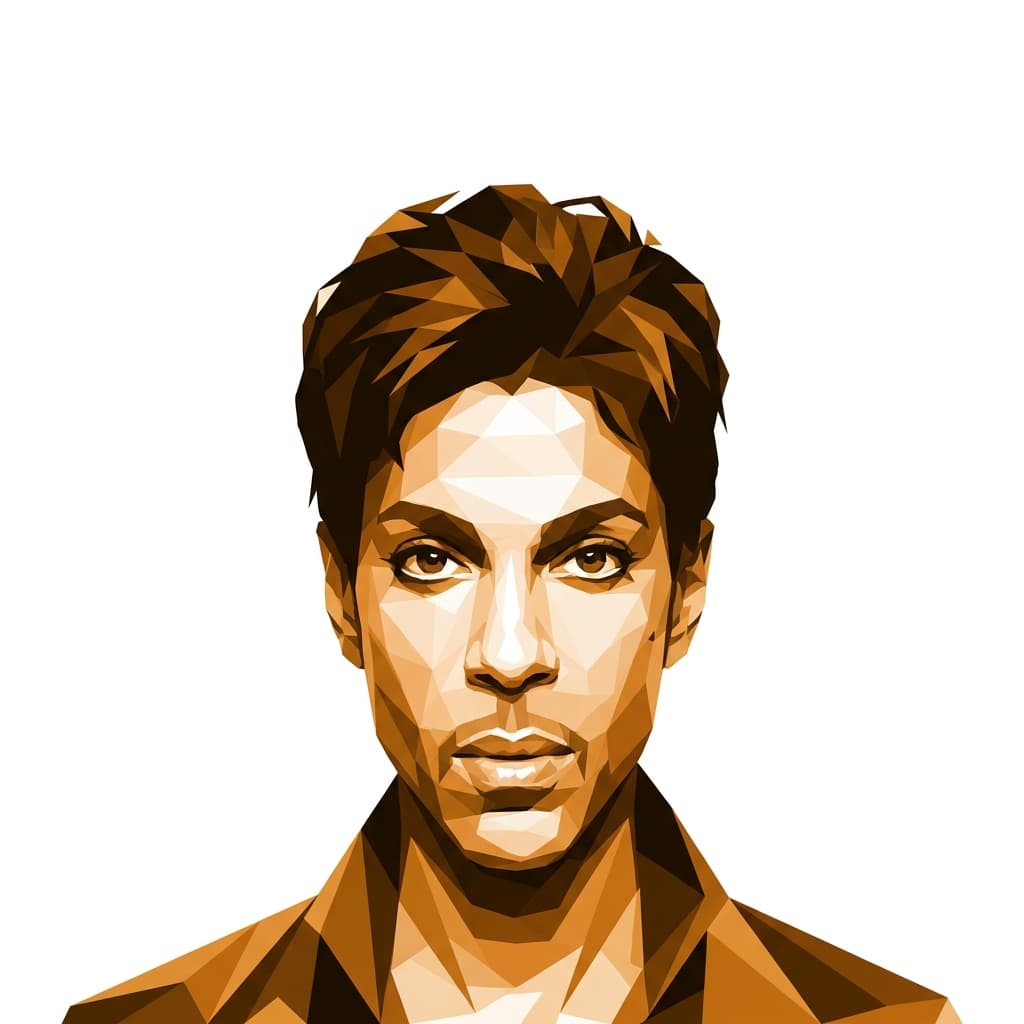
Genre-dissolving musician, producer, and performer who reinvented pop, funk, and rock from Minneapolis.
Design
- Q22.2
- h47.2
- R1.2
- g28.1
- i27.1
- S36.2
- T41.6
- U61.5
- V50.5
- W11.3
- X33.1
- Y28.3
- Z59.1
Personality
- Q35.6
- h5.6
- R55.2
- g50.5
- i3.5
- S20.5
- T24.1
- U25.3
- V32.2
- W11.1
- X33.2
- Y28.1
- Z29.6
Prince Rogers Nelson was a Manifesting Generator — wired to chase several passions at once and find the shortest path through them — and the volume of work he left behind reads exactly like that wiring turned all the way up. He produced his own debut at nineteen, played every instrument on it, and then spent four decades refusing to stop pivoting: funk record, rock record, jazz-adjacent record, side project under a different name, then a movie, then a Broadway-sized tour staged inside a nightclub. The Paisley Park vault, with its thousands of unreleased songs, is essentially what happens when a body built for following the next thing that lights it up never stops getting lit up.
His 6/2 profile — the role-model-in-training who needs solitude to recharge — shaped his public shape almost as much as his music did. The early Prince was experimental, sometimes chaotic, deliberately provocative; the middle Prince retreated behind a glyph, sued his label, wrote SLAVE on his face and largely vanished from the mainstream conversation; the late Prince emerged as an elder statesman whose surprise concerts and mentorship of younger artists carried the weight of someone who had lived through every version of the industry. He guarded his privacy ferociously, and the long stretches of withdrawal at Paisley Park were where the next reinvention always got assembled.
Musically he was an original who refused to sound like anyone else, which is partly why no genre label ever stuck cleanly to him. He'd take a pop hook, a James Brown horn line, a Hendrix guitar solo, and a drum-machine pattern nobody else was using, and the result somehow sounded like a single sealed idea. He was famously a perfectionist about studio ritual — late-night sessions, specific engineers, specific rooms, the same cycle of recording fast and editing later — and equally famous for demolishing whatever he'd just built to chase a new sound. Albums got shelved at the last minute. Bands got dissolved and reassembled. The Revolution, the New Power Generation, 3rdEyeGirl — each was a different vehicle for a different version of him.
His decision-making had the slow-burn quality of Emotional Authority: the public fights with Warner Bros., the name change, the eventual reconciliation years later, the careful staging of his comeback — none of these were impulse moves, even when they looked like provocations. He'd sit with something, ride the wave, and then act with a finality that surprised everyone who'd assumed he was bluffing. The same patience showed up in how he ran his bands, where he could sense which players were worth investing in long before the wider world caught on — Sheila E., Wendy & Lisa, Morris Day, Sheena Easton's best run, all bear his fingerprints.
Onstage he was present in a way that made every show feel like the only show, and the falsetto, the screams, the whispered asides were all part of a vocabulary built to hold a room at exact emotional pitch. He pulled enormous meaning out of struggles he chose deliberately — the label war, the Jehovah's Witness conversion, the reclamation of his masters — and treated each one as material. When he died in 2016, what was striking wasn't just the catalog but how much of it had been made in private, for himself, with the door closed, waiting for whichever version of Prince needed it next.
Sources: biography · birth data
What do you and Prince have in common?
Enter your birth details to find out