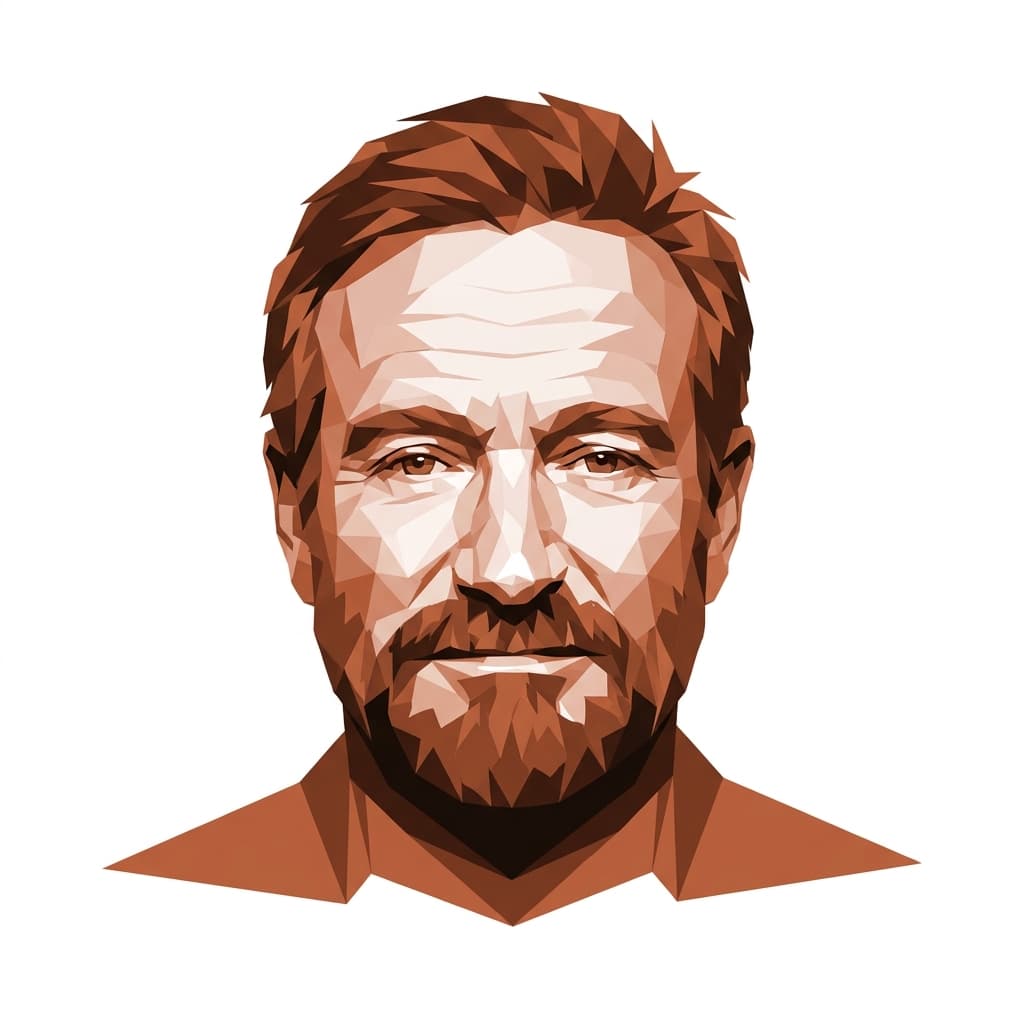
American comedian and actor whose manic improvisational genius reshaped stand-up and film comedy.
Design
- Q3.5
- h50.5
- R57.5
- g22.2
- i47.2
- S27.6
- T16.2
- U24.1
- V25.2
- W6.5
- X52.3
- Y57.3
- Z7.5
Personality
- Q56.2
- h60.2
- R37.4
- g37.6
- i40.6
- S4.4
- T40.5
- U39.3
- V21.5
- W6.6
- X39.2
- Y57.2
- Z7.6
Robin Williams was a Generator — built with deep stamina for one craft and the ability to pour himself into it for hours without tiring, which is exactly how he could hold a stage for three hours and leave an audience exhausted while he was still going. He grew up an only child in a wealthy Detroit suburb, often alone in a big house inventing voices for hundreds of toy soldiers. That early solitude wasn't a footnote; it was the workshop where the engine got built.
His 2/5 profile — the hermit who reluctantly becomes the savior — explains the lifelong contradiction friends always described. Offstage he was famously quiet, shy, sometimes withdrawn. Onstage, or when a camera turned on, he became the person the whole room needed: the one who could pull a wounded crowd back into laughter, the one called in to host the benefit, visit the children's hospital, headline the USO tour. People projected enormous things onto him, and his Wait to Respond energy meant he was almost always reacting — to a heckler, a co-star's setup, a prop on the table, a sound from the wings — rather than initiating from a script.
The comedy itself was a Generator's mastery built by ten thousand reps, refined nightly at the Holy City Zoo and the Improv until his free-association became frictionless. He had a mind that swept disparate references into sudden coherent shapes, riffing on Shakespeare, Reagan, and a rubber chicken inside a single breath, and underneath the speed was a real searcher's need to understand why people behaved the way they did. The voices weren't bits; they were tiny working theories about human beings.
His warmth was the other half. Dead Poets Society, Awakenings, Good Will Hunting — these performances came from someone with an instinct to nurture wounded people and a deep loyalty to the chosen family of his casts and crews. Christopher Reeve, his Juilliard roommate, called Robin the first person to make him laugh after his accident; Robin showed up in a surgical gown pretending to be a proctologist. That was the caregiving instinct fused to the comic one — care delivered as a joke because direct tenderness would have been too much for either of them.
The provocations were part of it too. He could say the dangerous thing that made a room admit what it was actually feeling, and his emotional weather ran high and low in big sweeping waves that he didn't always have time to ride out before the next press junket, the next film, the next yes. Cocaine and alcohol in the late seventies, sobriety, relapse in 2006, sobriety again. The shadow of his Type — saying yes to everything, working past the point of joy — sat very close to him.
In his final years he carried what was later diagnosed as Lewy body dementia, a disease that erodes exactly the cognitive fluency his entire art depended on. He died in August 2014. What he left was the rare proof that unguarded innocence can survive a lifetime of being looked at.
Sources: biography · birth data
What do you and Robin Williams have in common?
Enter your birth details to find out