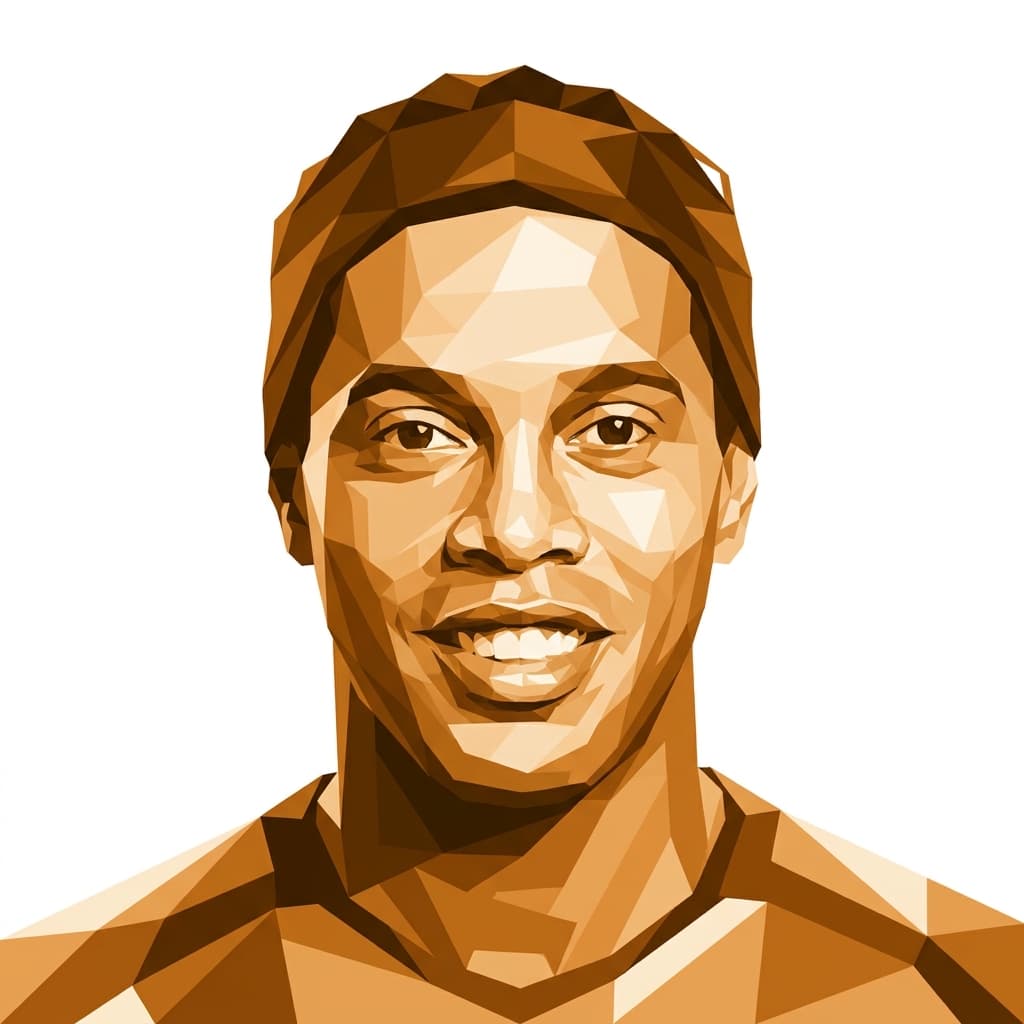
Brazilian football magician whose joyful, improvisational genius redefined the beautiful game in the 2000s.
Design
- Q10.5
- h15.5
- R22.3
- g59.1
- i55.1
- S26.1
- T41.2
- U64.2
- V40.5
- W6.5
- X43.6
- Y26.4
- Z32.1
Personality
- Q25.3
- h46.3
- R20.3
- g29.5
- i30.5
- S37.2
- T2.3
- U29.4
- V59.3
- W6.1
- X14.1
- Y11.1
- Z32.1
Ronaldinho Gaúcho was a Manifesting Generator — wired to chase joy at speed, juggle several passions at once, and skip whatever steps didn't feel essential — and the arc of his career reads exactly like that. He arrived at Paris Saint-Germain as a curly-haired 21-year-old already famous in Brazil, and by the time he left Barcelona five years later he had reorganized how the world thought about creativity on a football pitch. What made him different wasn't just the tricks; it was that he did all of it while visibly, unmistakably having fun.
The trademark grin wasn't performance. It was a signal that his gut was lit up, and the football that followed — the no-look passes, the elastico, the crossbar free kick against Chelsea — came out of that state. Coaches who tried to systematize him quickly learned that Ronaldinho played best when he was allowed to course-correct mid-move, reading the game one heartbeat ahead and improvising the fastest route to goal. Frank Rijkaard's Barcelona figured this out and built a team around his instincts; the 2005 and 2006 La Liga titles, the Champions League in Paris, and back-to-back Ballon d'Or and FIFA World Player wins followed.
His 3/5 profile — the experiential trial-and-error learner who becomes a magnetic problem-solver — showed up in how he approached every match. He didn't rehearse tricks; he tried them, live, and discovered what worked by getting his hands dirty in real time. The famous Santiago Bernabéu performance in 2005, when Real Madrid fans stood to applaud him, was the payoff of a player who treated the pitch as an ongoing experiment — and who let the rest of us come along for the ride. Kids in São Paulo and Barcelona started doing keepie-uppies against walls because he made it look like the point of the whole thing.
Off the pitch, his emotional authority told a different story. Big decisions — leaving Barcelona for Milan, the drift through Flamengo and Atlético Mineiro, the endings that felt premature — often came at emotional peaks or lows rather than from a settled, clear place. Nightclubs in Barcelona, a famously loose relationship with training schedules, the pull toward extremes of celebration and rest — all of it fit a man whose energy demanded variety but whose choices sometimes ran ahead of his own clarity. Pep Guardiola inheriting the squad in 2008 and moving him on was, in retrospect, a decision made for him.
What endured was the child-like innocence he carried through every setback — the bankruptcies, the confiscated passport, the messy legal troubles of later years. He kept smiling, kept saying yes to the next thing, kept showing up in futsal cages and charity matches like a kid who couldn't quite believe he was allowed to play. He was never precise about the future; he was precise about the moment, fully present with the ball at his feet, and that presence was the entire trick.
His legacy is less a trophy cabinet than a permission slip. Messi has said openly that Ronaldinho taught him it was possible to be world-class and joyful at the same time — that the two weren't opposites. A generation of Brazilian and European footballers learned the same lesson by watching him laugh his way through defenders.
Sources: biography · birth data
What do you and Ronaldinho have in common?
Enter your birth details to find out