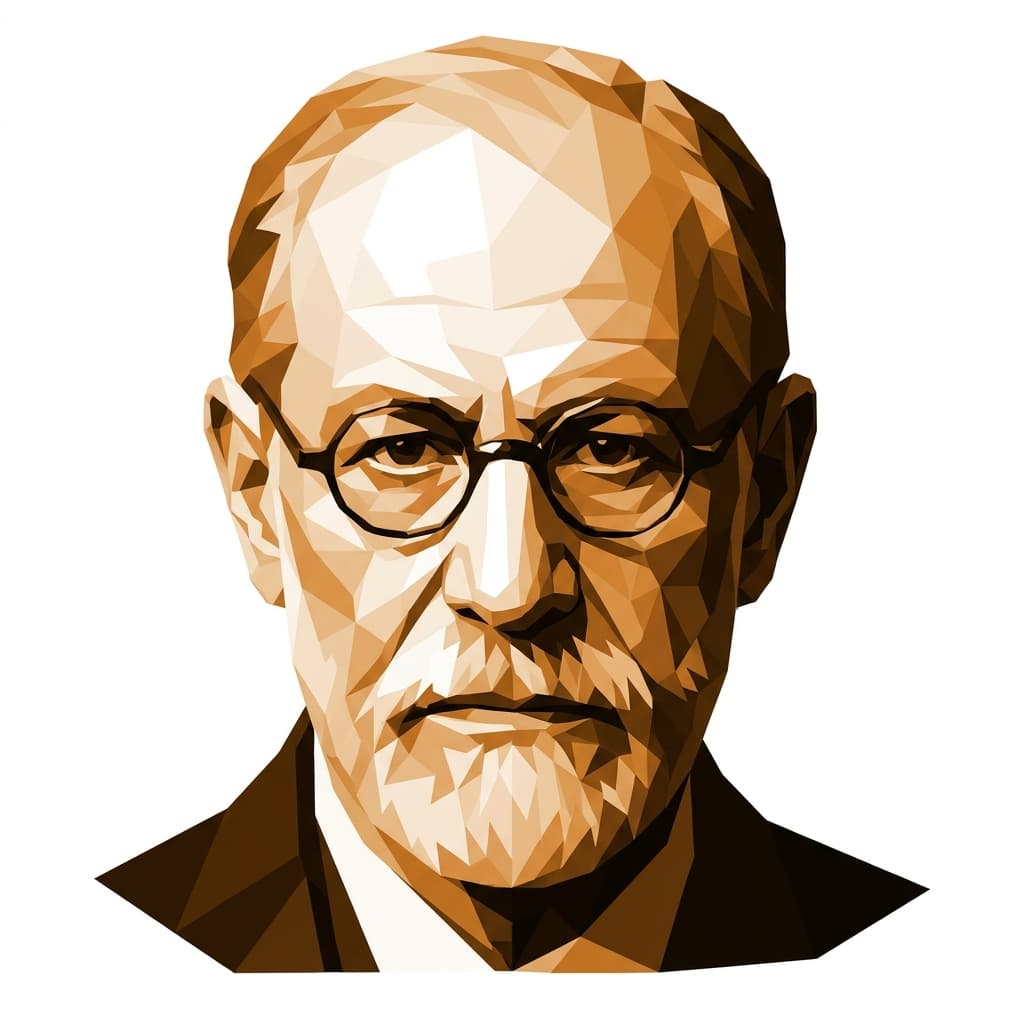
Austrian neurologist who founded psychoanalysis and reshaped how the modern world understands the unconscious mind.
Design
- Q13.6
- h7.6
- R37.3
- g3.1
- i50.1
- S55.5
- T58.5
- U57.6
- V37.4
- W12.1
- X2.4
- Y63.6
- Z27.1
Personality
- Q2.4
- h1.4
- R35.4
- g42.4
- i32.4
- S8.4
- T42.6
- U46.6
- V25.2
- W12.6
- X23.2
- Y22.4
- Z27.3
Sigmund Freud was a Manifesting Generator — someone wired to chase multiple obsessions in parallel and cut corners on his way to a synthesis nobody else had seen. Trained as a neurologist in Vienna, he spent his twenties dissecting eel gonads, experimenting with cocaine as a local anesthetic, translating Charcot's lectures on hysteria, and drifting between the lab, the clinic, and the café. The through-line was never a career plan; it was a nose for what mattered, followed by a burst of energy toward it.
His breakthrough came less from a single insight than from an instinct for what was worth preserving and what had to be dismantled. When his mentor Josef Breuer got spooked by the erotic transference of the Anna O. case, Freud kept going. He listened to hysterical women in ways almost no nineteenth-century physician would — hours at a time, day after day, letting them talk. Out of that patience came the "talking cure," and out of that came a whole new way of ordering the chaos of the psyche: id, ego, superego; repression, displacement, sublimation. He was building a system in real time.
The Interpretation of Dreams (1900) is a good place to see his 4/6 profile at work. A book aimed squarely at the small circle who might actually understand it, it sold poorly for years before becoming foundational. Freud gathered a Wednesday-night discussion group — Adler, Stekel, later Jung, Ferenczi, Rank — and ran it like a family salon. He was warm inside the circle and merciless outside it. When Jung broke with him in 1913, Freud reportedly fainted; the loss was not just intellectual but the wound of someone whose whole method depended on trusted inner-circle bonds.
His clinical style was built on listening as a form of excavation, sitting behind the couch so patients would free-associate without a face to perform for. He was a chain-smoker of cigars, wrote in the evenings after a full day of analytic hours, and moved between moods that ran deep — emotional weather he treated as data rather than noise. His prose is famously good; even his wrongest arguments read well, because he had a gift for making a strange idea sound inevitable. He waited, often for decades, until the culture was ready to hear him — and when it was, the timing of his sentences did as much work as their content.
Freud was also a stubborn man who often mistook his own certainties for science, and later readers have had to separate the durable insights from the ones cooked by his era and his ego. But his ambition was real: to make the invisible interior of a person into something that could be studied, argued about, revised. He kept working through jaw cancer, through thirty-plus surgeries, through the Nazi annexation of Austria that finally drove him to London in 1938. He died there in 1939, having asked his physician for a lethal dose of morphine — a last act of taking a cycle to its intentional end.
Sources: biography · birth data
What do you and Sigmund Freud have in common?
Enter your birth details to find out