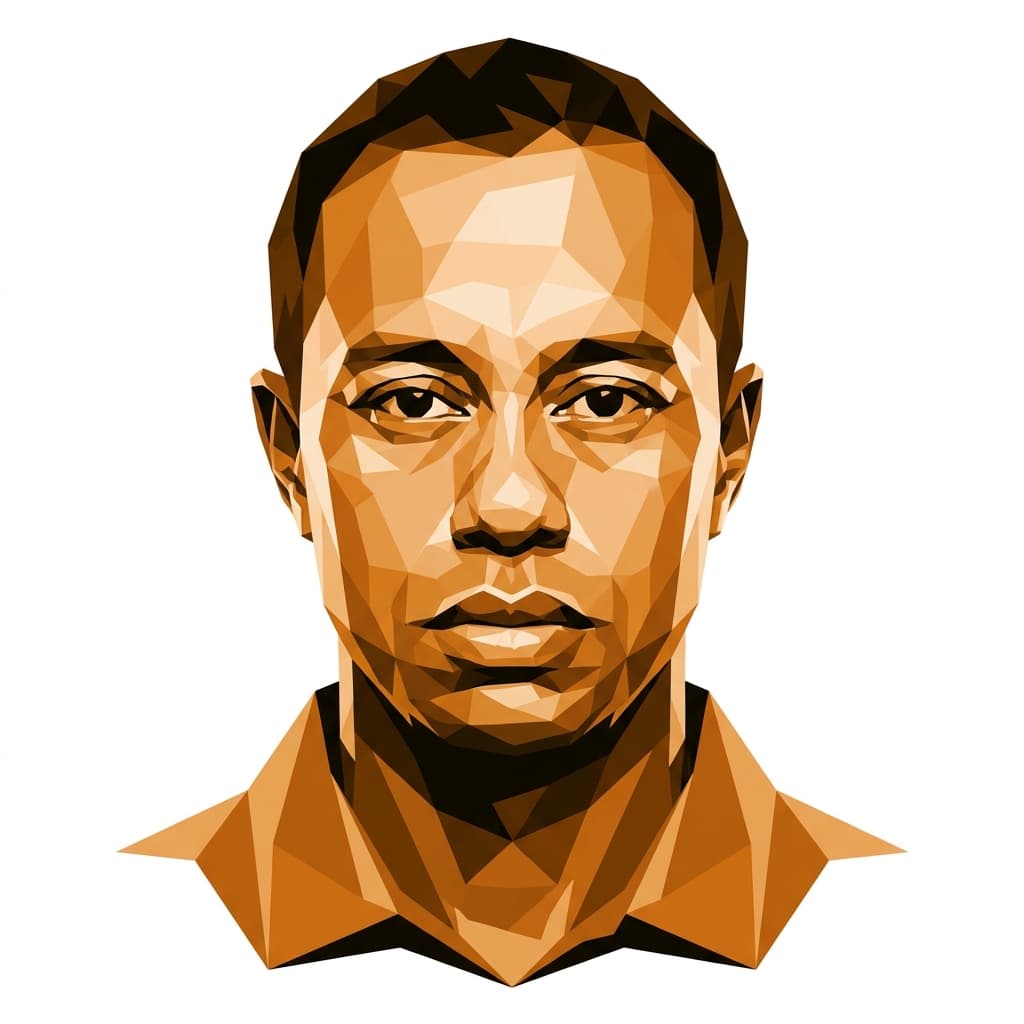
American golfer who redefined the sport, winning 15 majors and dominating professional golf for decades.
Design
- Q48.2
- h21.2
- R18.3
- g43.4
- i23.4
- S57.6
- T59.1
- U12.4
- V42.1
- W56.6
- X50.6
- Y9.5
- Z18.6
Personality
- Q58.6
- h52.6
- R26.6
- g43.3
- i23.3
- S60.1
- T14.5
- U45.1
- V51.1
- W56.6
- X28.5
- Y5.2
- Z48.3
Tiger Woods is a Manifesting Generator — built for sustained, obsessive output on one thing while quietly running several other engines underneath (fitness, course design, business, family). From the moment his father put a putter in his hands before he could walk, Tiger's career has been the story of a body that knew what it wanted long before anyone asked his mind to weigh in.
His path fits a 6/2 profile almost too neatly: a spectacular first act of raw experimentation (1997 Masters at 21, a rewritten record book by 30), a brutal middle act of injury, scandal, and withdrawal, and a third act — the 2019 Masters comeback — where he stepped back onto the course as a role model for what survival and reinvention actually look like. The long stretches of self-imposed exile between tournaments, the way he'd disappear to rebuild a swing from scratch three separate times, all track with someone who needs deep solitude to metabolize what he's living.
On the course, his decision-making has always been an instant, wordless yes from the body. Watch him over a chip at Augusta in 2005 — the ball hovering on the lip before dropping — and you're watching someone who trusts what his gut has already committed to before his conscious mind catches up. He famously refused to explain his club selections in press conferences; he didn't have language for it because language wasn't where the answer lived. His ability to hold absolute stillness over a putt while a gallery of ten thousand people held its breath became the sport's defining image.
The texture of his greatness is in the granular obsession. He rebuilt his swing under Butch Harmon, then again under Hank Haney, then again under Sean Foley — tearing down what worked to chase what could be better, even when critics said he was mad to fix what wasn't broken. He treated his body like a research project: military training, ultramarathon-style runs, a punishing daily rhythm that never really varied. He wanted to be the best who ever lived, and he was willing to sell that ambition as its own kind of product — Nike swoosh, red Sunday shirt, the fist pump — long before athlete branding was a real industry.
His fall was as public as any in modern sports: the 2009 scandal, the DUI, four back surgeries, the mugshot. What made the return possible wasn't talent alone but a capacity for meaningful struggle that seemed almost engineered into him — the sense that punishment and pursuit were the same thing. When he won the 2019 Masters, embracing his son Charlie behind the 18th green in an inversion of his own father's embrace in 1997, he closed a cycle that had been left painfully open for eleven years.
He remains, at 49, a voice the entire sport still organizes itself around — designing courses, running his TGL indoor golf league, watching his son play amateur events. The revolutionary way he thought about power, precision, and preparation permanently changed what a professional golfer is expected to be. The game before Tiger and the game after Tiger are different games.
Sources: biography · birth data
What do you and Tiger Woods have in common?
Enter your birth details to find out