American author who reshaped science fiction and fantasy through anthropological imagination and quiet moral force.
Design
- Q56.5
- h60.5
- R49.1
- g2.6
- i1.6
- S62.1
- T35.6
- U64.1
- V16.4
- W11.3
- X21.2
- Y29.6
- Z53.4
Personality
- Q50.2
- h3.2
- R35.4
- g24.5
- i44.5
- S48.1
- T46.5
- U44.4
- V35.5
- W11.4
- X17.6
- Y59.4
- Z53.5
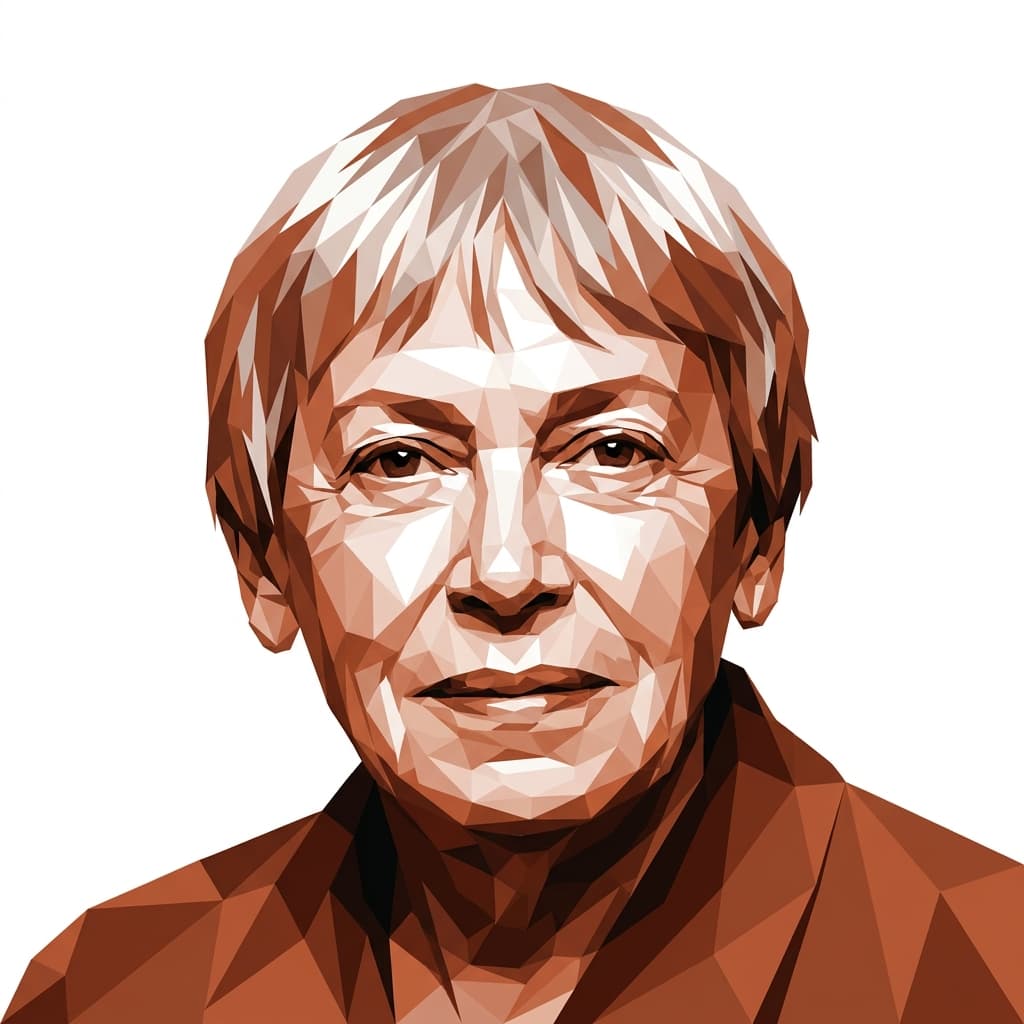
Ursula K. Le Guin was a Generator — built for the long, patient labor of mastering a craft and powered by the kind of sustained energy that produced more than twenty novels, a dozen story collections, poetry, essays, and translations across six decades. She wrote nearly every morning at her desk in Portland, Oregon, for most of her adult life, and the steadiness was the point. She wasn't chasing inspiration; she was responding to it, waiting for the story that genuinely lit her up before committing.
The daughter of anthropologists Alfred and Theodora Kroeber, she grew up around scholars, Native Californian elders, and an enormous library. That upbringing shows up everywhere in her work — the deep contemplative habit of building whole frameworks for invented worlds, the cultures and languages of Earthsea and the Hainish cycle worked out with the precision of someone who needed the anthropology to hold together. She didn't publish her first novel until she was 37. The apprenticeship had been long and largely private, which suited her 2/5 profile — the hermit who is nevertheless pulled into public life to solve problems others can't.
She was famously private, and famously decisive. When her gut said no, it said no. The 1973 National Book Award speech for The Farthest Shore, the 1986 "Bryn Mawr Commencement Address," her blistering 2014 National Book Foundation speech against Amazon and the commodification of literature — these were full-bodied yeses from a writer who didn't bother explaining the reasoning. She turned down a Nebula in 1976 to protest the Science Fiction Writers of America's treatment of Stanisław Lem. She rewrote her own earlier work when she decided she'd gotten the gender politics wrong. The willingness to revise her principles in public and demand the field follow was unusual and entirely characteristic.
The Left Hand of Darkness (1969) and The Dispossessed (1974) did something science fiction hadn't quite done before: they used the genre's freedom to seriously imagine other arrangements of gender, economy, and power. She was bringing order to a literature she found philosophically lazy, and she did it without polemic — through character, through landscape, through the slow accumulation of detail. Earthsea, which began as a young-adult assignment, became a lifelong reckoning. She returned to it three decades later in Tehanu and The Other Wind to tell the story again from the margins she'd originally excluded.
Her essays and her famous translation of the Tao Te Ching show a different register — the teacher making old ideas feel newly habitable, trusting that confusion in a reader is often the doorway to real understanding. She wrote about writing with the same care, in Steering the Craft and The Wave in the Mind, generously handing over the tools she'd spent a lifetime sharpening.
She died in 2018 at 88, in the house she'd lived in for over half a century. The work she left behind keeps doing what she meant it to do: arguing, quietly and at length, that other worlds are possible — and that imagining them well is serious moral labor.
Sources: biography · birth data
What do you and Ursula K. Le Guin have in common?
Enter your birth details to find out