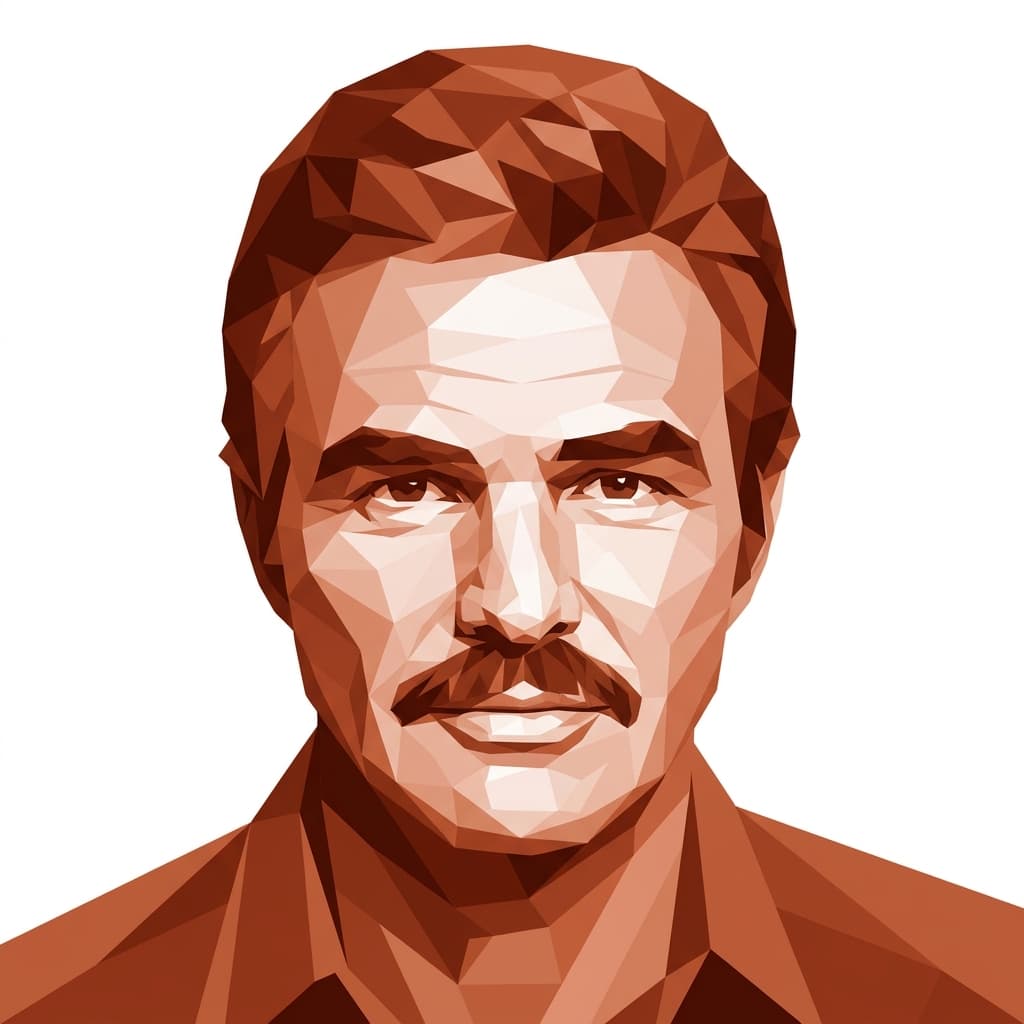
American actor, football-player-turned-movie-star known for Deliverance, Smokey and the Bandit, and Boogie Nights.
Design
- Q43.6
- h23.6
- R7.1
- g38.5
- i39.5
- S44.4
- T18.4
- U38.6
- V34.2
- W55.4
- X27.1
- Y64.6
- Z56.2
Personality
- Q49.4
- h4.4
- R18.6
- g38.3
- i39.3
- S60.6
- T54.3
- U22.6
- V26.3
- W37.5
- X3.6
- Y64.5
- Z62.6
Burt Reynolds was a Generator — built for sustained, physical, satisfying work, which is exactly how he lived until the work stopped being satisfying and everything cracked. Before Hollywood he was a halfback at Florida State with an NFL future ahead of him, and the knee injury and car accident that ended football sent him toward acting almost by accident. He didn't chase stardom so much as wait for the thing that lit up his gut, taking bit parts, television westerns, and stunt work through the late fifties and sixties without any obvious plan.
The breakthrough came at 36 with Deliverance, and it came the way a 4/6 profile tends to work — years of experimenting in the wilderness, then a role that installed him as an example of a certain kind of American masculinity almost overnight. The nude Cosmopolitan centerfold he shot that same year was pure Reynolds: a provocation designed to pull a reaction out of the room, which he later said he regretted because it may have cost him an Oscar nomination. He could feel the culture around him and nudge its emotional temperature on purpose, and he did it constantly on talk shows, in interviews, in the sly wink he built into every performance.
Smokey and the Bandit, The Longest Yard, Hooper, Cannonball Run — for a stretch in the late seventies he was the number one box office star in the world, and he did it by selling movies most critics thought were unsellable. He understood the Bandit persona was a product, and he marketed it with total commitment. He also directed, produced, opened a dinner theater in Jupiter, Florida, ran an acting school out of it, and generally behaved like someone who couldn't stop turning his energy into things that got built. His loyalty to a small circle of stunt guys, coaches, and old Florida friends was legendary — the community he'd grown up in stayed the community he worked with.
Then came the long collapse. A jaw injury on the set of City Heat in 1984 led to years of pain, painkillers, tabloid rumors that he had AIDS, a brutal divorce from Loni Anderson, and a bankruptcy filing in 1996 with debts north of ten million dollars. Decisions he'd made from inside emotional weather — the movies he greenlit, the properties he bought, the fights he picked — showed what happens when choices get made from the top of the wave instead of the calm after it. He admitted later that he'd turned down Terms of Endearment, Die Hard, and the James Bond franchise, and that most of those nos were mood-driven.
Boogie Nights in 1997 was the comeback, and it worked because Paul Thomas Anderson essentially asked him to play a version of himself — the aging showman who'd survived his own excess. Reynolds famously hated the film and fired his agent for pushing him toward it, but the Oscar nomination arrived anyway. In his final decades he taught acting, wrote a candid memoir, and told stories about his own past with a warmth that reframed the mess as material. He'd been a reluctant role model who mostly wanted to be recognized for the craft, and by the end, largely, he was.
Sources: biography · birth data
What do you and Burt Reynolds have in common?
Enter your birth details to find out