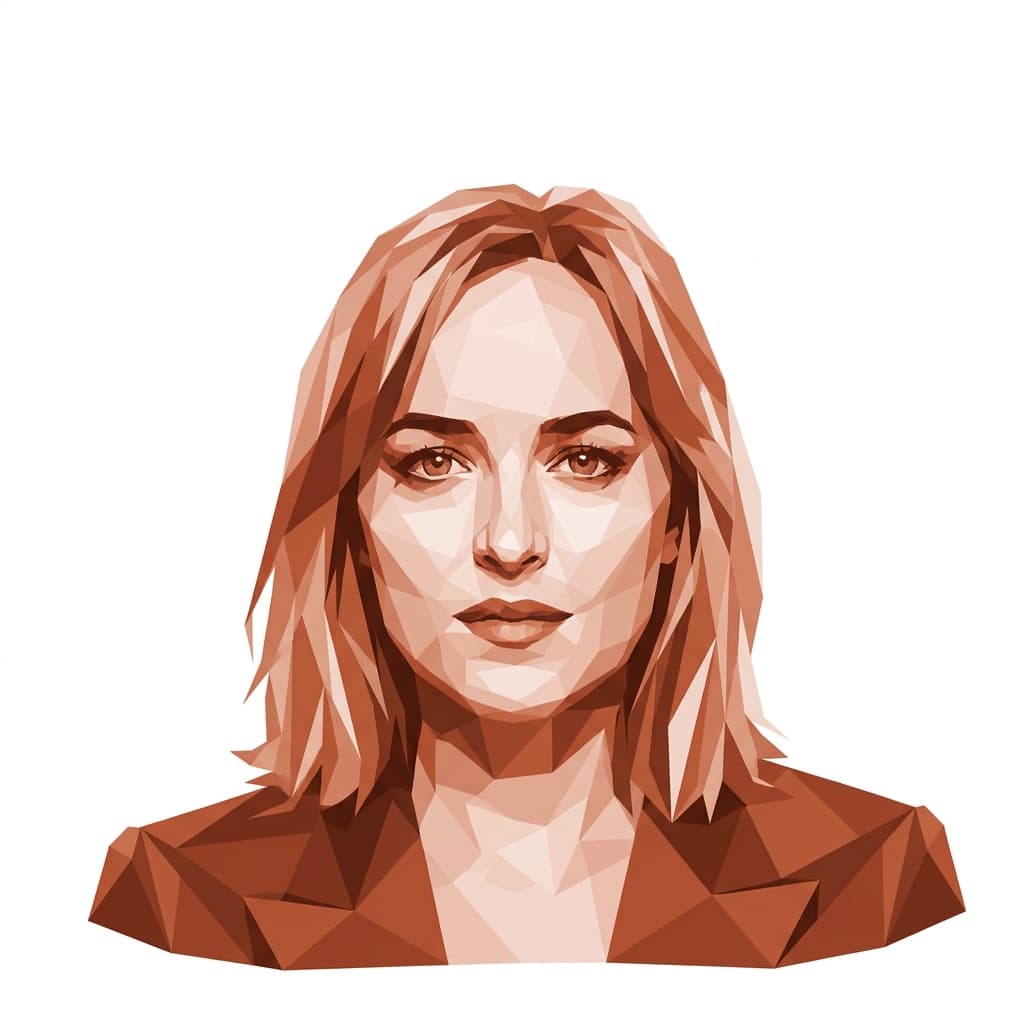
American actress and producer known for Fifty Shades, indie roles, and disarmingly candid press appearances.
Design
- Q39.5
- h38.5
- R7.1
- g30.3
- i29.3
- S15.2
- T33.1
- U33.5
- V12.3
- W38.1
- X10.5
- Y38.2
- Z44.6
Personality
- Q48.3
- h21.3
- R34.6
- g30.1
- i29.1
- S6.4
- T14.2
- U48.1
- V39.1
- W58.5
- X10.4
- Y38.1
- Z1.1
Dakota Johnson is a Generator — built for sustained, satisfying work when the gut says yes, and quietly allergic to anything that doesn't light her up. That temperament has shaped a career that looks, from the outside, like a series of surprising choices: the daughter of Melanie Griffith and Don Johnson could have coasted on pedigree, but she keeps picking projects that seem to interest exactly her and almost no one's marketing department.
Her breakout as Anastasia Steele in Fifty Shades of Grey was a case study in waiting for the right thing to show up and then fully committing to it. She has said publicly that the shoots were often miserable, that she fought for the character, that she wouldn't do it again — and yet she stayed locked in for three films because she'd said yes. That combination of follow-through and open dissatisfaction is very on-brand. She'll finish the job. She'll also tell you exactly how it went.
Johnson has a 3/5 profile, the experimenter-turned-reluctant-authority, and it reads all over her filmography. Suspiria, The Peanut Butter Falcon, A Bigger Splash, Cha Cha Real Smooth, Daddio — she treats her career like a series of experiments, some of which don't work, and she's remarkably unbothered by the ones that don't. The Ellen interview about only being invited once, the Architectural Digest limes, the Madame Web press tour where she cheerfully agreed the movie was strange: these are all the same person telling the truth about her own experience in real time, which is exactly what a 3/5 does when they stop pretending to have it all figured out.
Under the deadpan is a very specific instrument. Her voice — low, dry, delivered with immaculate timing — is the whole comedic engine of her press appearances, and it works because she knows precisely when to land a line and when to let silence do it. On screen she works in a similar register: small, exact gestures, a lot said with very little. Her performance in The Lost Daughter and her narration in A Bigger Splash both trade on saying only what needs saying and letting the rest sit. She's a producer now too, through her company TeaTime Pictures, which fits — she'd rather quietly run the resources than be handed a script.
She's talked openly about depression, about sleeping ten hours a night, about needing solitude to function. She loves limes, apparently, and her house, and a small circle of people. There's a selectiveness about who gets close that reads as aloofness from the outside and is probably just accurate self-knowledge. When she does show up — for Chris Martin, for Maggie Gyllenhaal's directorial debut, for a niche indie no one asked her to do — it's with the kind of full-bodied yes that doesn't need to explain itself.
The through-line is that she's genuinely funny about her own trial and error, and she's not particularly interested in the version of a movie-star career that requires pretending otherwise. She's building a different one, at her own pace, with obvious appetite for the parts that actually interest her.
Sources: biography · birth data
What do you and Dakota Johnson have in common?
Enter your birth details to find out