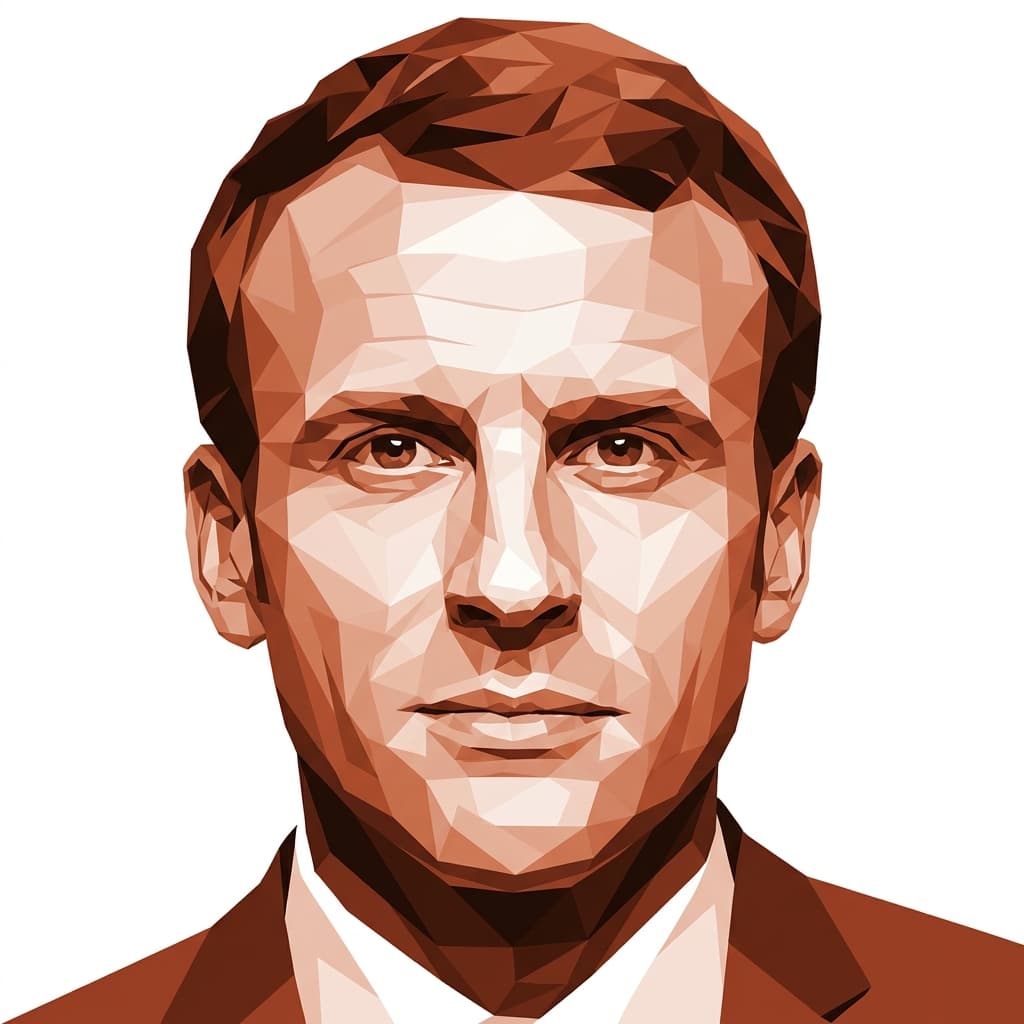
French president since 2017, former investment banker who founded En Marche and reshaped French politics.
Design
- Q46.4
- h25.4
- R30.4
- g57.1
- i51.1
- S64.4
- T59.3
- U39.5
- V52.1
- W29.2
- X44.3
- Y5.3
- Z48.5
Personality
- Q10.2
- h15.2
- R2.2
- g48.3
- i21.3
- S10.2
- T26.6
- U33.4
- V15.4
- W59.1
- X1.2
- Y5.6
- Z57.2
Emmanuel Macron is a Generator — built for sustained, high-output work when something genuinely lights him up, and his rise from provincial student to youngest French president in history reads like a case study in what that engine can do when it's aimed. He grew up in Amiens, played piano seriously, fell in love with his drama teacher Brigitte (twenty-four years his senior), and by his early thirties had passed through Sciences Po, the ENA, the Rothschild bank, and the Élysée as François Hollande's economic advisor. Each step looked like a leap; each was actually a response to something already in front of him.
His 2/4 profile — the hermit who is nonetheless known — helps explain a politician who reads Ricœur and Hegel in private and then delivers marathon press conferences in public. Friends describe long stretches of solitude, books, piano, writing; then he emerges with a fully-formed position and works the room like someone who has been preparing to be seen his whole life. En Marche, the movement he founded in April 2016, was quite literally built through his network of relationships — old classmates, Rothschild colleagues, sympathetic mayors — rather than any traditional party machinery.
The decision to leave Hollande's government in August 2016 and run for president as a 39-year-old with no party is the clearest example of his gut moving faster than his advisors could argue against it. Everyone told him to wait, to build, to run in 2022. He went anyway. That same instinct shows up in his taste for the unexpected, disruptive move — dissolving the National Assembly in June 2024 after the European elections, a snap call that stunned even his own cabinet and cost him his majority. He treats politics as a place to provoke the country into saying what it actually thinks, which is either his gift or his liability depending on the week.
The Rothschild years sharpened a real talent: he made the Nestlé–Pfizer baby-food deal work, earning a reputation as someone who could close. As president he has channeled that into a fascination with managing France's resources, industries and grand projects personally — reindustrialization, nuclear revival, Choose France summits held at Versailles. He has a pattern-reader's instinct for where Europe is drifting, articulated in the 2017 Sorbonne speech and again in 2024, warning that the continent could "die" without strategic autonomy. Whether or not you buy the diagnosis, the diagnostic reflex is constant.
The shadow side is well-documented. The "Jupiterian" presidency, the "people who are nothing" remark, the pension reform pushed through by decree — all moments where a Generator said yes to too many fights at once and burned goodwill he might have kept. He can seem to love the depth of an argument more than the room he's arguing in, lecturing where a lighter touch would land better. Yet he keeps returning to the same small set of anchoring rituals — the walks with Brigitte, the piano, the long-form interviews — and to a stubborn conviction that being unmistakably himself is the whole point of the office, even when half of France wishes he'd tone it down.
Sources: biography · birth data
What do you and Emmanuel Macron have in common?
Enter your birth details to find out