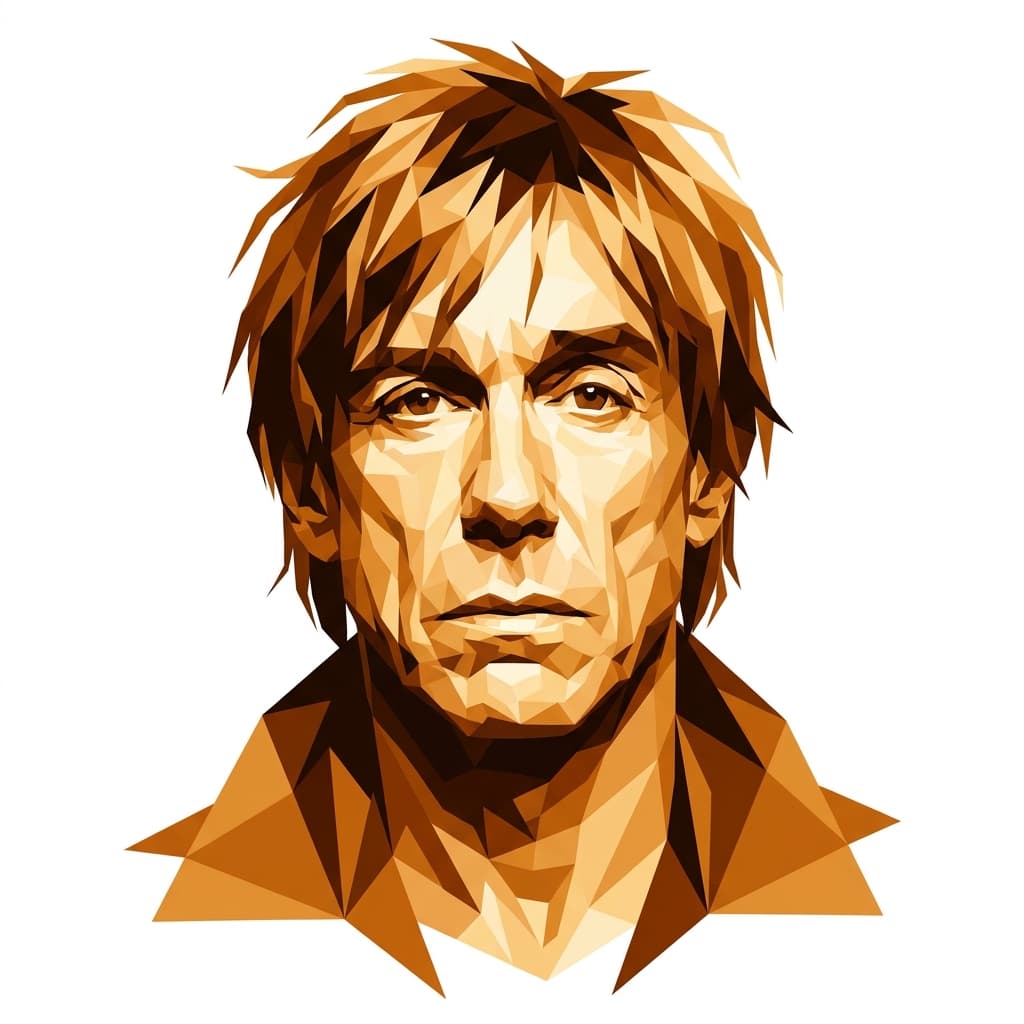
Proto-punk godfather, Stooges frontman, and shirtless survivor whose raw stage presence rewired rock and roll.
Design
- Q41.1
- h31.1
- R13.4
- g16.6
- i9.6
- S41.1
- T5.5
- U60.3
- V43.6
- W31.4
- X45.2
- Y48.2
- Z33.6
Personality
- Q3.5
- h50.5
- R27.6
- g20.3
- i34.3
- S17.5
- T36.4
- U17.4
- V14.1
- W31.1
- X45.3
- Y18.6
- Z33.4
Iggy Pop — born James Newell Osterberg Jr. in a Muskegon trailer park — is a Manifesting Generator, wired to chase several obsessions at once and burn through them at a speed most bands couldn't survive. The through-line of his career, from The Stooges' 1969 debut to his late-period collaborations with Josh Homme, is exactly that: a non-linear detonation of blues, punk, cabaret, spoken word, and radio hosting, none of it planned, all of it lit by what his gut said yes to next.
The Stooges started when Iggy, then a drummer for local Ann Arbor bands, saw The Doors in 1967 and felt the full-body pull that skips right past thinking. He didn't want to play like Morrison; he wanted to be the confrontation itself. Within two years he was rolling in broken glass, smearing peanut butter on his chest, and inventing the stage dive. That's the raw physical engine that had to move or burn out — a Manifesting Generator's motor pointed at the audience like a weapon.
His 5/1 profile, the practical fixer who has to research everything from the ground up first, shows up in the parts of the Iggy story nobody talks about. Behind the chaos was a voracious reader — Egyptology, Céline, Roman history — the kind of investigator who disappears to build a foundation before returning with something new to show. When Bowie pulled him out of a Los Angeles psychiatric ward in 1976, the two of them decamped to Berlin and Iggy essentially apprenticed himself to a new sound, emerging with The Idiot and Lust for Life.
The Berlin records also revealed his gift for listening long enough to know exactly what the moment needed — hearing Bowie's chord changes and dropping in lyrics that felt lived rather than written. "The Passenger" came from riding the S-Bahn and reading Jim Morrison poems. "Lust for Life" was banged out in minutes to a rhythm Bowie tapped on a ukulele. Iggy has always been the one who says the true thing at the exact second it lands, whether that's a lyric or a between-song aside to a hostile crowd.
Then came the wilderness decades — the heroin years, the flop albums, the shirtless variety-show appearances that seemed like career suicide until, somehow, they became the brand. He kept pivoting without apologizing for the pivot, doing jazz standards on Préliminaires, hosting a beloved BBC 6 Music show where his taste ranges from Sun Ra to Sleaford Mods, showing up in Jim Jarmusch films. He treats each new form as a craft worth immersing in until he becomes it.
What's kept him alive and interesting into his seventies is a hard-won willingness to work with the body's limits instead of against them. The man who once cut himself open onstage now swims every morning, keeps a Miami routine, and speaks candidly about the toll. The Stooges reunited, Ron and Scott Asheton died, and Iggy kept going — not because he planned to, but because something in him is still responding to what shows up, and the answer is usually yes.
Sources: biography · birth data
What do you and Iggy Pop have in common?
Enter your birth details to find out