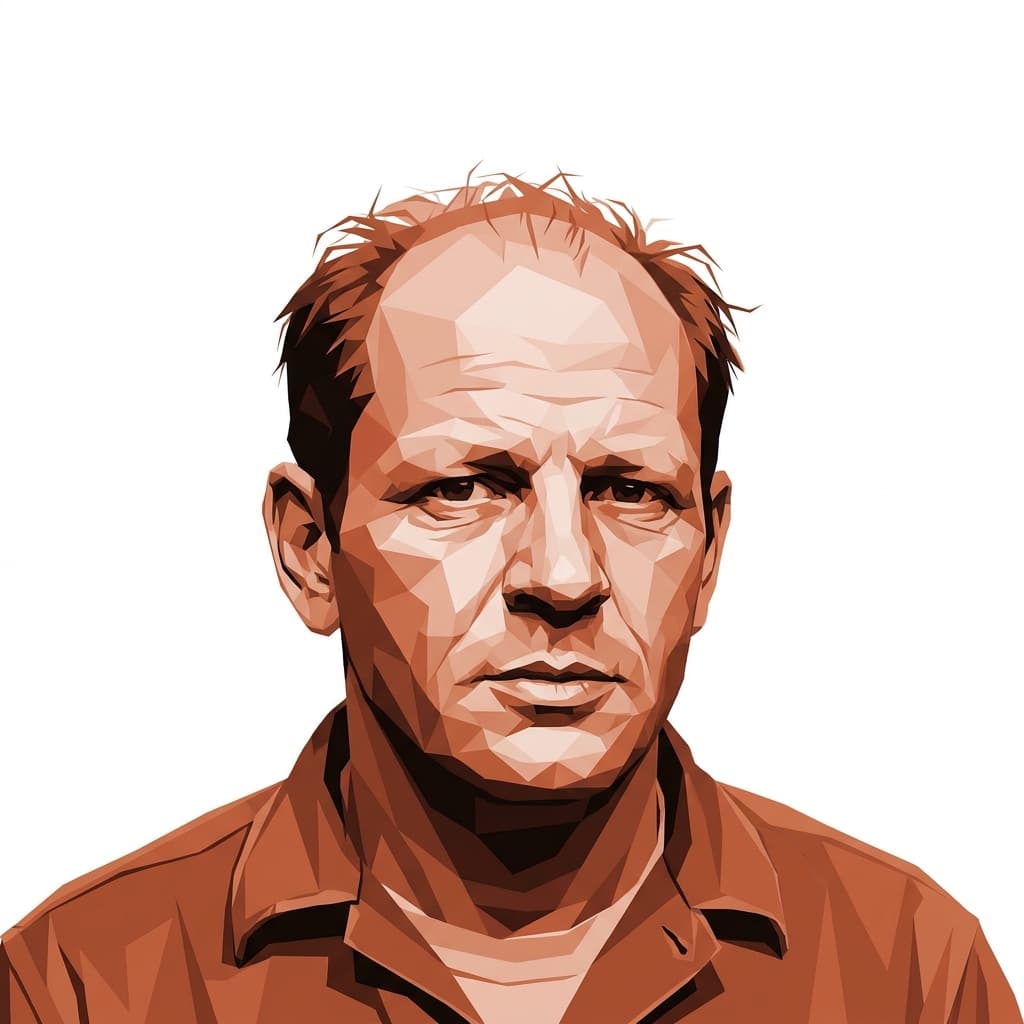
American abstract expressionist painter who pioneered the drip technique and redefined modern art.
Design
- Q44.3
- h24.3
- R36.1
- g3.5
- i50.5
- S1.3
- T6.3
- U16.4
- V43.4
- W2.5
- X61.6
- Y62.4
- Z15.1
Personality
- Q41.6
- h31.6
- R8.2
- g42.5
- i32.5
- S54.2
- T10.1
- U8.6
- V9.5
- W2.1
- X60.4
- Y62.2
- Z12.5
Jackson Pollock was a Generator — built for the long, physical, repetitive labor of making, and his work bears the unmistakable signature of someone who could pour energy into a canvas until the canvas itself became a record of stamina. Born in Cody, Wyoming in 1912 and raised across the American West, he arrived in New York in 1930 to study under Thomas Hart Benton, dragging behind him a restless temperament that would never quite settle. For most of the 1930s and early 40s he painted in a representational, mythic mode — Jungian symbols, totems, animals — circling something he couldn't yet name.
The breakthrough came in 1947, when he took canvas off the easel, laid it on the floor of his Springs, Long Island barn, and began flinging, dripping, and pouring household enamel directly from cans and sticks. It looked like chaos to almost everyone who saw it. To Pollock it was order pulled out of apparent disorder, a system he understood from the inside. He worked within tight constraints he set for himself — the floor, the can, the stick, the body's reach — and inside those limits found a vocabulary no one had used before. "I am nature," he told Hans Hofmann, refusing the idea that he was painting from anything but his own gut.
Friends and critics noted how Pollock seemed to enter the canvas — circling it, stepping in, moving with the sustained, hours-long focus of someone who could disappear into a single task. The drip paintings of 1947–1950 — Number 1A, Autumn Rhythm, Lavender Mist, One: Number 31 — were made in bursts of intense physical engagement, his body answering a knowing that arrived without explanation. He didn't sketch. He didn't plan. He responded to what the paint did, and then responded again, and again, until the painting told him it was done. This was a gut-led process that refused to justify itself in words, and when interviewers pressed him for theory he mostly went quiet or got irritated.
Hans Namuth's 1950 films and photographs of Pollock working turned him into the first American art celebrity — Life magazine asking whether he was the greatest living painter in the United States. The attention sat badly on him. He had the kind of unmistakably original voice that becomes a brand whether you want it to or not, and the role of tastemaker and emblem of a new American art flattened the work into a stunt for people who'd never looked at it carefully. He drank heavily through most of his adult life, fell off the wagon definitively after 1950, and the late paintings grew darker, more figurative, more haunted.
His marriage to Lee Krasner held the whole structure together for as long as it could. She managed his career, edited his instincts, kept the studio running. By 1956 the drinking and the affairs had broken them; he died that August driving drunk into a tree near his home, age forty-four. The 6/3 arc — years of trial, error, and visible mess feeding a later wisdom — got cut off before the role-model phase could arrive. What remains is the work itself, an experiment carried out by someone who learned only by doing, and an entire postwar generation of painters trying to figure out what he had actually done on that barn floor.
Sources: biography · birth data
What do you and Jackson Pollock have in common?
Enter your birth details to find out