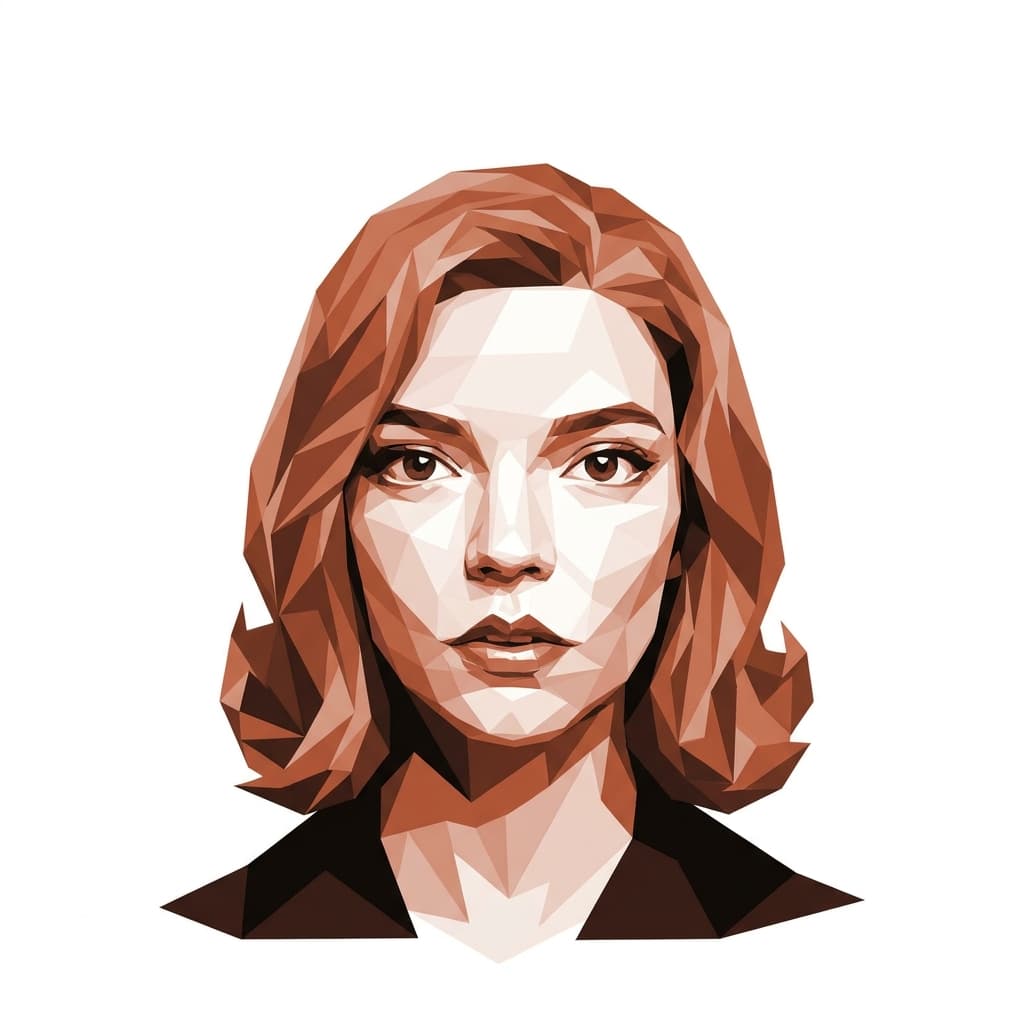
Argentine-British-American actress known for The Queen's Gambit, Emma, and Furiosa.
Design
- Q60.3
- h56.3
- R38.6
- g32.1
- i42.1
- S60.1
- T55.6
- U19.2
- V10.6
- W22.5
- X60.5
- Y61.5
- Z34.3
Personality
- Q3.1
- h50.1
- R17.5
- g57.3
- i51.3
- S2.2
- T35.1
- U51.3
- V54.3
- W25.4
- X41.3
- Y60.2
- Z34.3
Anya Taylor-Joy is a Generator — built with the stamina to dive deep into a craft and stay there, working through the tedious middle until mastery arrives. She learned chess for seven weeks straight to play Beth Harmon in The Queen's Gambit, and the show's most quietly hypnotic moments are her face doing arithmetic without moving a muscle. That kind of absorption isn't performance energy; it's the work of following a full-bodied yes into something and refusing to leave until it's done.
Born in Miami to an Argentine-Scottish mother and Anglo-Argentine father, she spent her early childhood in Buenos Aires, then moved to London at six speaking only Spanish. She has said she was bullied for her looks, her voice, and her accent, and eventually dropped out of school. Being scouted outside Harrods as a teenager wasn't a rescue so much as something showing up that finally lit her gut up. She didn't chase acting; acting arrived, and she recognized it.
Her 1/3 profile — the investigator who also learns by falling on her face — shows up in how she talks about her early work. She calls The Witch, her breakout, a project she almost couldn't watch herself in, and she's been openly candid about the films that didn't work, treating the misses as tuition rather than failure. She researches obsessively before a role and then throws herself into the doing, willing to look ridiculous in service of learning something real. That combination — the deep foundation plus the willingness to experiment in public — is why her filmography swings so widely: horror, Jane Austen, animated video-game movies, Miller's Furiosa.
On set she has a reputation for preparing until the character is bone-deep — training months for Furiosa, learning to move like a specific kind of animal, treating the physical craft as non-negotiable. There's a quality in her work of meeting intensity without flinching, whether it's Puritan witchcraft, dissociative identity disorder in Split, or the wordless grief of a survivor in the Wasteland. Directors keep casting her in roles that require holding enormous psychic weight quietly, and she keeps staying open-hearted through material that would close most people down.
Off-camera she's warmer and stranger than her severe screen presence suggests — she talks fast, laughs at herself, wears couture with obvious delight, and describes her own aesthetic choices with a self-possession that doesn't ask permission. She's spoken about being deeply attuned to her characters' feelings, sometimes losing herself in them, which reads as the flip side of a gift for sensing the emotional weather of a scene before the camera rolls. Her friendships in the industry — with the Radcliffe/Coppola/Miller circle — seem built on this same frequency.
She's still in the restless, hungry phase of an actor who wants to try everything, moving between blockbusters and small auteur projects with no visible strategy beyond "the story pulled me." Which, for a Generator following her gut, is exactly the strategy. She's assembling a body of work by feel, one full-bodied yes at a time, and the shape of it will only become clear looking backward.
Sources: biography · birth data
What do you and Anya Taylor-Joy have in common?
Enter your birth details to find out