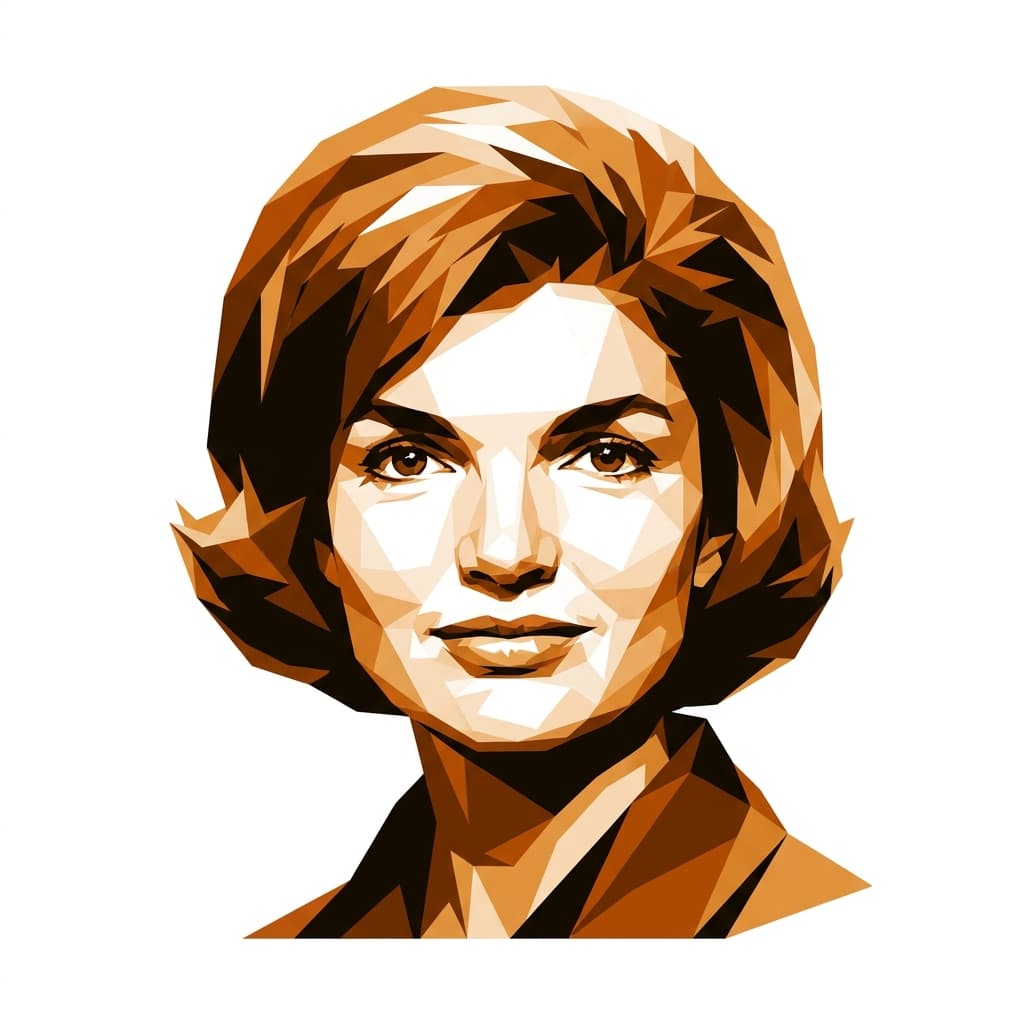
American First Lady, style icon, and editor who redefined public grace and private reinvention.
Design
- Q27.6
- h28.6
- R26.6
- g23.3
- i43.3
- S2.6
- T42.5
- U62.2
- V23.1
- W10.3
- X17.6
- Y29.5
- Z53.2
Personality
- Q31.4
- h41.4
- R42.6
- g2.5
- i1.5
- S31.1
- T45.6
- U64.4
- V16.5
- W11.3
- X21.2
- Y59.1
- Z53.4
Jacqueline Kennedy Onassis was a Manifesting Generator — built to move through several lives at once rather than settle into a single fixed identity, and the arc of her biography is exactly that. Debutante of the Year at eighteen, Inquiring Camera Girl for the Washington Times-Herald at twenty-two, First Lady at thirty-one, widow at thirty-four, shipping magnate's wife at thirty-nine, and book editor at forty-six — each chapter arrived when something specific showed up in front of her and she followed the gut pull rather than the plan.
Her 4/6 profile, the community-anchored role model, shaped everything about how she operated. She was famously loyal to a small circle — the Bouviers, the Auchinclosses, a handful of friends from Miss Porter's and Vassar — and near-impenetrable to everyone else. In the White House, she picked her collaborators from that trusted network and let them do the work: Oleg Cassini on wardrobe, Stéphane Boudin on the state rooms, Letitia Baldrige on protocol. She wasn't trying to charm all of Washington. She was investing in the few relationships where trust ran genuinely deep, and letting the rest of her influence radiate outward from there.
The 1962 televised White House tour is a study in her particular gifts. She had spent months in the archives and warehouses, tracking down Monroe furniture and Lincoln china, and she narrated the results in that famous whispery voice — a masterclass in distilling complex history into something anyone could follow. The restoration itself was pure Gate 21 in action: she took control of a national resource nobody else was managing well, secured congressional legislation to protect it, and ran the project her way. Fifty-six million people watched. It won her an honorary Emmy and permanently changed how Americans thought about the house.
Then Dallas. What people remember is the pink Chanel suit she refused to change out of — "let them see what they've done" — and the veiled composure at the funeral, modeled deliberately on Mary Lincoln's. Both were choices. She had the kind of certainty that arrives whole and doesn't need to be talked through, and she used it to script three days of national ritual in under seventy-two hours: the riderless horse, the eternal flame, the walk behind the caisson. It was, among other things, an act of caring for a country that needed a container for its grief.
The Onassis marriage baffled the public, which was rather the point — she had watched a president and a brother-in-law die and wanted privacy, protection, and a life on her own terms. When that chapter ended too, she started over again as an editor at Viking and then Doubleday, acquiring roughly a hundred books over nineteen years on subjects that genuinely interested her: ballet, Egyptology, Michael Jackson's Moonwalk. She read manuscripts on the subway. She answered her own phone. It was the least glamorous of her lives and, by several accounts, the one she loved most — a quiet return to the beginnings she'd always been drawn to, doing work she could fully commit to without performing.
Sources: biography · birth data
What do you and Jacqueline Kennedy Onassis have in common?
Enter your birth details to find out