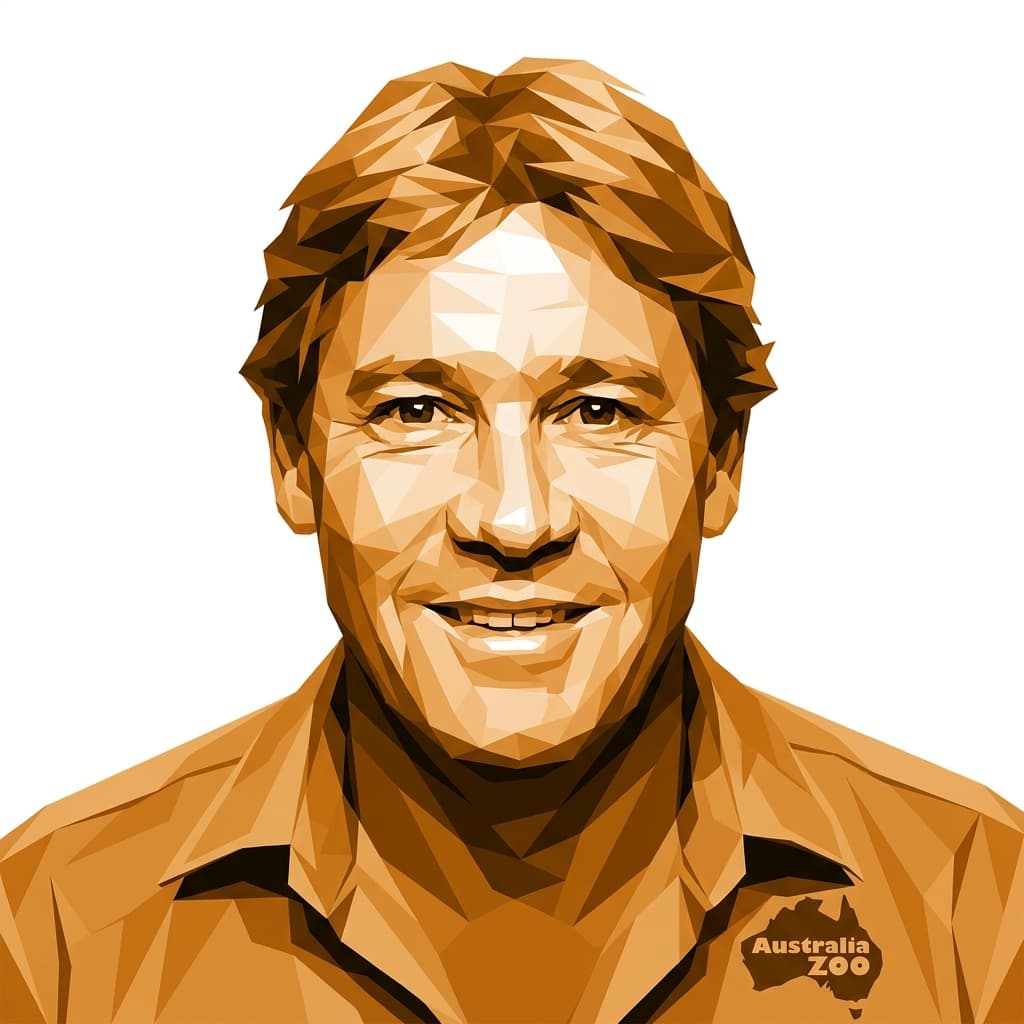
Australian wildlife conservationist and television personality known as "The Crocodile Hunter."
Design
- Q34.5
- h20.5
- R56.3
- g4.3
- i49.3
- S43.6
- T43.1
- U9.4
- V41.2
- W61.6
- X59.1
- Y44.5
- Z40.5
Personality
- Q55.3
- h59.3
- R6.3
- g7.6
- i13.6
- S19.1
- T37.4
- U13.3
- V49.4
- W41.4
- X29.5
- Y1.1
- Z40.4
Steve Irwin was a Manifesting Generator — wired to move fast, juggle a dozen passions, and barrel toward whatever lit him up next — and his whole life ran at that tempo. He grew up at the Beerwah Reptile Park his parents founded in Queensland, was handling snakes by age six, and wrestling crocodiles in the wild by nine. By the time he inherited the park in 1991 and renamed it Australia Zoo, he'd already spent years on solo croc-capture missions in Far North Queensland, sleeping in the bush, learning the animals one mistake at a time.
That hands-on, scraped-knuckles education is pure 3/5 profile territory — the experimenter who learns by doing and then turns around to teach the world what they've lived. When The Crocodile Hunter premiered in 1996, audiences weren't watching a polished naturalist; they were watching a man who'd genuinely been bitten, charged, and chased, narrating it all with the disarming honesty of someone reporting from inside the experiment. His "Crikey!" was real. The mud on his khakis was real. People trusted him because he was visibly figuring it out in front of them.
His decisions had the look of impulse but ran on something deeper. Steve made big calls — buying land for conservation, expanding the zoo, taking the show global — by sitting with them, talking them out with Terri, letting the emotional charge settle before committing. When he met Terri Raines on a 1991 zoo tour, he proposed within months; but those who knew him noted it wasn't sudden — he'd been waiting for the right thing to show up for a long time, and his gut said yes loudly enough that the rest was just timing.
What made him singular was the combination of raw physical engine and emotional transparency. He had the kind of vitality that powered eighteen-hour days in the heat and could not sit still for a meeting that wasn't about animals. He spoke in the present tense, on-camera and off, saying what needed saying the instant it occurred to him, which is why he could narrate a death roll while a four-meter croc was inches from his leg. His love for wildlife wasn't sentimental — it was a fierce, principled commitment to creatures who couldn't speak for themselves, and it bled into everything: the Wildlife Warriors nonprofit, the buying-up of habitat, the refusal to ever stage a kill for ratings.
He was also, famously, a people person who treated his zoo staff like family and a father who brought his daughter Bindi on-camera at eight weeks old — which drew criticism he absorbed and largely ignored, because he believed the next generation needed to see animals to love them. The restless drive to keep launching new expeditions, new shows, new conservation projects never let up; he was filming an underwater documentary off Batt Reef in September 2006 when a stingray barb pierced his chest. He was 44.
Steve's wisdom was never theoretical. It was the practical knowing that comes from getting close enough to be hurt, then telling everyone what you learned. He turned a small reptile park into a global conservation engine, and made an entire generation care about the animals nobody else would touch.
Sources: biography · birth data
What do you and Steve Irwin have in common?
Enter your birth details to find out