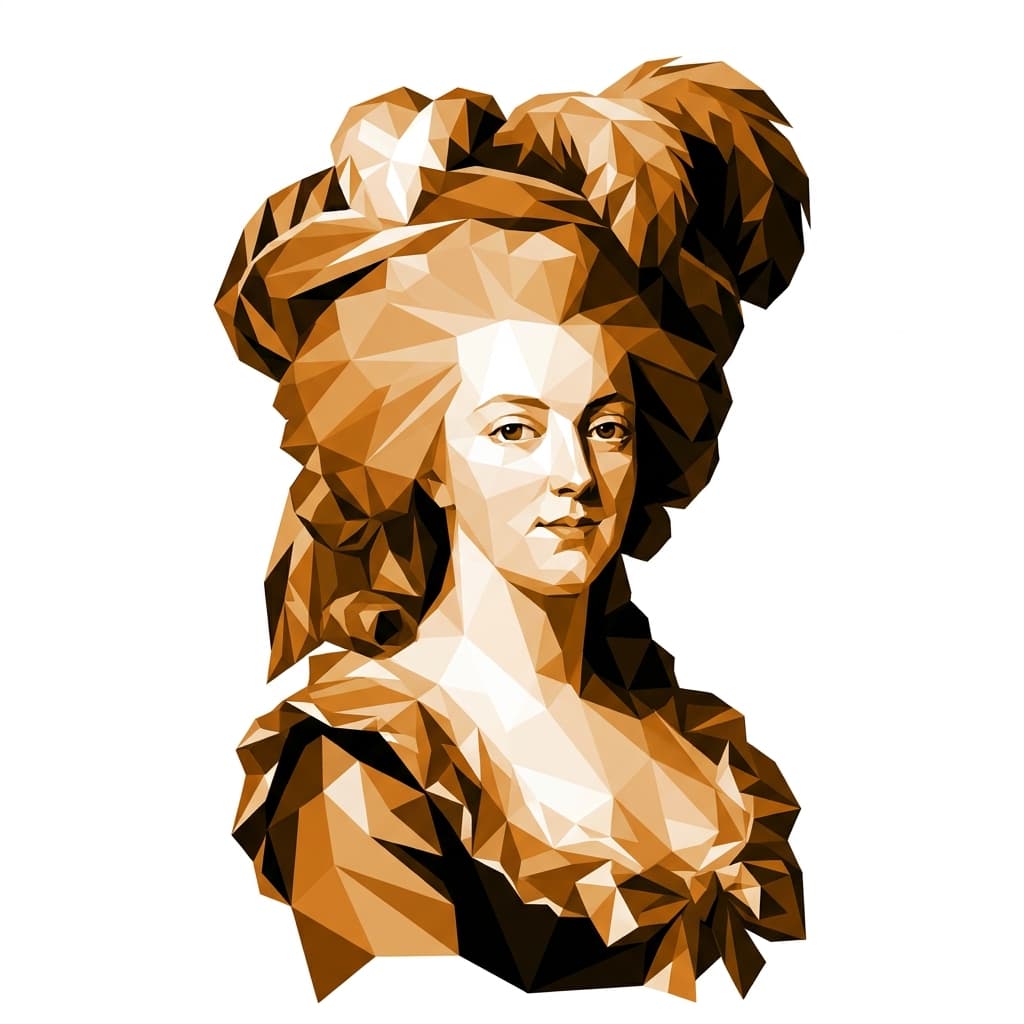
The last Queen of France before the Revolution, whose extravagance and isolation became emblems of a doomed monarchy.
Design
- Q33.5
- h19.5
- R52.2
- g47.5
- i22.5
- S7.1
- T53.6
- U20.3
- V47.3
- W61.4
- X63.4
- Y33.2
- Z5.3
Personality
- Q44.3
- h24.3
- R57.6
- g47.3
- i22.3
- S34.4
- T44.5
- U53.2
- V18.5
- W61.3
- X63.1
- Y33.4
- Z5.4
Marie Antoinette was a Manifesting Generator — wired for speed, appetite, and multiple simultaneous passions — dropped into a court whose entire architecture was designed to slow her down. She was fourteen when she arrived at Versailles, a Habsburg archduchess handed off to the French dauphin like a diplomatic bond note, and almost immediately she began doing what people of her type do when boxed in: she chafed, she pivoted, she chased what lit her up. The tragedy of her life is that the constraints never lifted, and the pivots kept getting more expensive.
Her 3/5 profile is the shape of learning by doing and getting projected on for it. The 3 line is the experimenter, the one who tries things and breaks them and tries again; the 5 line attracts enormous projection, both savior-fantasy and scapegoat. Both were operating at full volume in her case. She tested her way through court life without a manual, starting new fashions, new gardens, new theatricals, new intimate circles at the Petit Trianon — and each experiment became evidence in the case the public was already building against her. When Parisians needed a face for the monarchy's failures, her 5-line magnetism did the rest.
Her Strategy of waiting for what lit her up before acting worked beautifully in the private sphere — the milk-house dairy at the Trianon, the amateur operas, the intimate suppers — and disastrously in the political one, where she was expected to have opinions on grain prices she'd never asked to hear about. Her gut-first decision-making meant she picked favorites the way she picked ribbons: instantly, viscerally, and without a defense she could articulate to a hostile parliament. The Polignac circle, the Swedish count Axel von Fersen — these were full-body yeses in a role that required careful nos.
Versailles ran on rigid choreography and ceremonial rhythm — who handed the Queen her chemise, in what order, at what hour — and she found most of it absurd. She built the Petit Trianon partly as an escape into her own tempo, and her critics never forgave her for it. Meanwhile the pamphleteers were doing their own work: sensing the mood of a nation before its rulers did, reading which past resentments could be recycled into new rage, and hanging every one of them around her neck. The "Let them eat cake" line she never said stuck because the public had already decided who she was.
In the final years she came into a stranger, harder version of herself. Under house arrest at the Tuileries and then the Temple, she became the one holding the family steady while the King drifted, coordinating escape attempts, coded correspondence, back-channel diplomacy with Austria. The woman who had been mocked for frivolity showed a startling capacity for stillness and endurance in prison, and a quiet dignity in her final weeks that even hostile witnesses noted. At her trial she answered the obscene charge against her by turning to the mothers in the room — an instinctive, present-moment reply that briefly turned the courtroom. It wasn't enough. She was thirty-seven.
Sources: biography · birth data
What do you and Marie Antoinette have in common?
Enter your birth details to find out