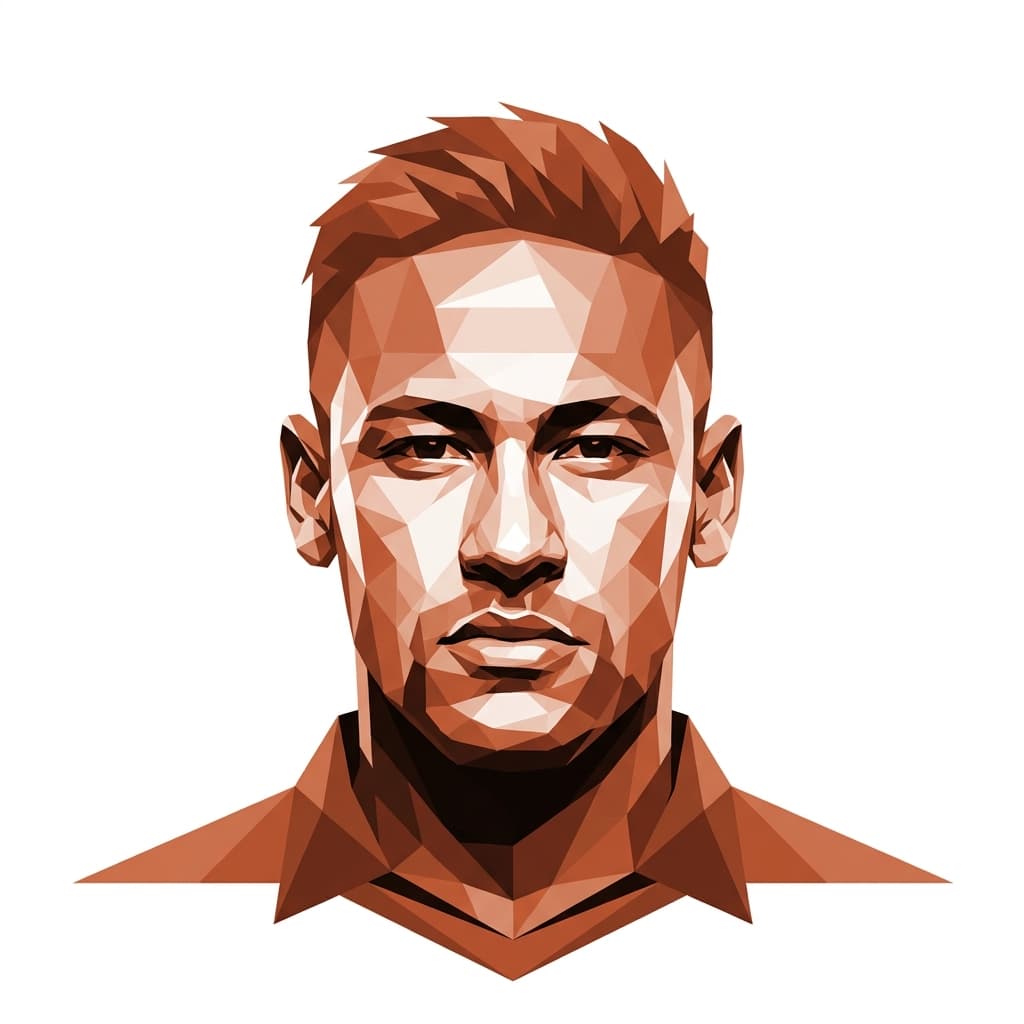
Brazilian football superstar known for dazzling dribbling, theatrical flair, and a career shaped by Santos, Barcelona, and PSG.
Design
- Q1.5
- h2.5
- R10.6
- g38.2
- i39.2
- S9.3
- T46.4
- U1.4
- V40.6
- W60.6
- X38.2
- Y38.6
- Z43.2
Personality
- Q13.3
- h7.3
- R55.1
- g58.6
- i52.6
- S19.3
- T38.5
- U54.6
- V64.2
- W19.3
- X54.1
- Y54.3
- Z43.5
Neymar da Silva Santos Júnior is a Generator — built with the deep, renewable stamina to train, play, and improvise for hours when the joy is there, and to visibly deflate when it isn't. From the moment he emerged at Santos as a teenager with a mohawk and an unreadable body feint, his football has been powered less by tactical rigor than by whether the game in front of him lights him up.
His rise followed a 3/5 profile arc: the experimenter who learns by doing, then gets projected onto as a savior. Brazil crowned him the heir to Pelé before he'd finished puberty; Barcelona paired him with Messi and Suárez expecting fireworks; PSG made him the most expensive player in history and asked him to deliver a Champions League. Some of those bets paid, others didn't, and Neymar has spent his whole career learning in public, mistakes and all, often with the world treating each setback as scandal rather than data.
He plays like someone in constant conversation with what excites him in the moment — the rainbow flick, the sombrero, the nutmeg that serves no purpose except delight. When the mood is right, he pours pure creative signature into every touch and lifts the entire team around him; when it isn't, the same match can dissolve into petulance and rolling on the grass. That volatility is the tell of decisions made mid-emotional-wave rather than after it settles: contract sagas, transfer dramas, and public feuds that later look like choices made in a spike rather than from a cool, clear place.
Off the pitch, he's magnetically loyal to a small circle — his father as manager, childhood friends as entourage, teammates he adopts as brothers. There's a strong pull toward providing for the people he came up with, and a matching sensitivity to whether that provision is appreciated. He fights hard for what he considers his — scrapping over honor, pride, and slights that others might let go — which makes him a nightmare for defenders and, sometimes, for referees, federations, and tax authorities.
His most quoted moments are provocations: the goal celebrations that troll opponents, the interviews that rearrange a locker room, the samba-loud parties that draw sponsor concern. It's the gift for stirring emotion into the open, used sometimes as art and sometimes as weapon. When it works, teammates play looser and crowds ignite. When it doesn't, he becomes the story instead of the football, and the emotional highs and lows that fuel his best play tip into melodrama.
The chronic ankle and foot injuries that have shadowed his career point at the deepest tension in his design: a body that keeps insisting on rest, recovery, and its own timing inside a machine that demands he play through everything. His best football — the 2013 Confederations Cup, the 2015 Barcelona treble, the Olympic gold in Rio — arrived when he felt genuinely lit up. His hardest years have been the ones spent trying to force performance from a body and a heart that were asking, plainly, for something else.
Sources: biography · birth data
What do you and Neymar have in common?
Enter your birth details to find out