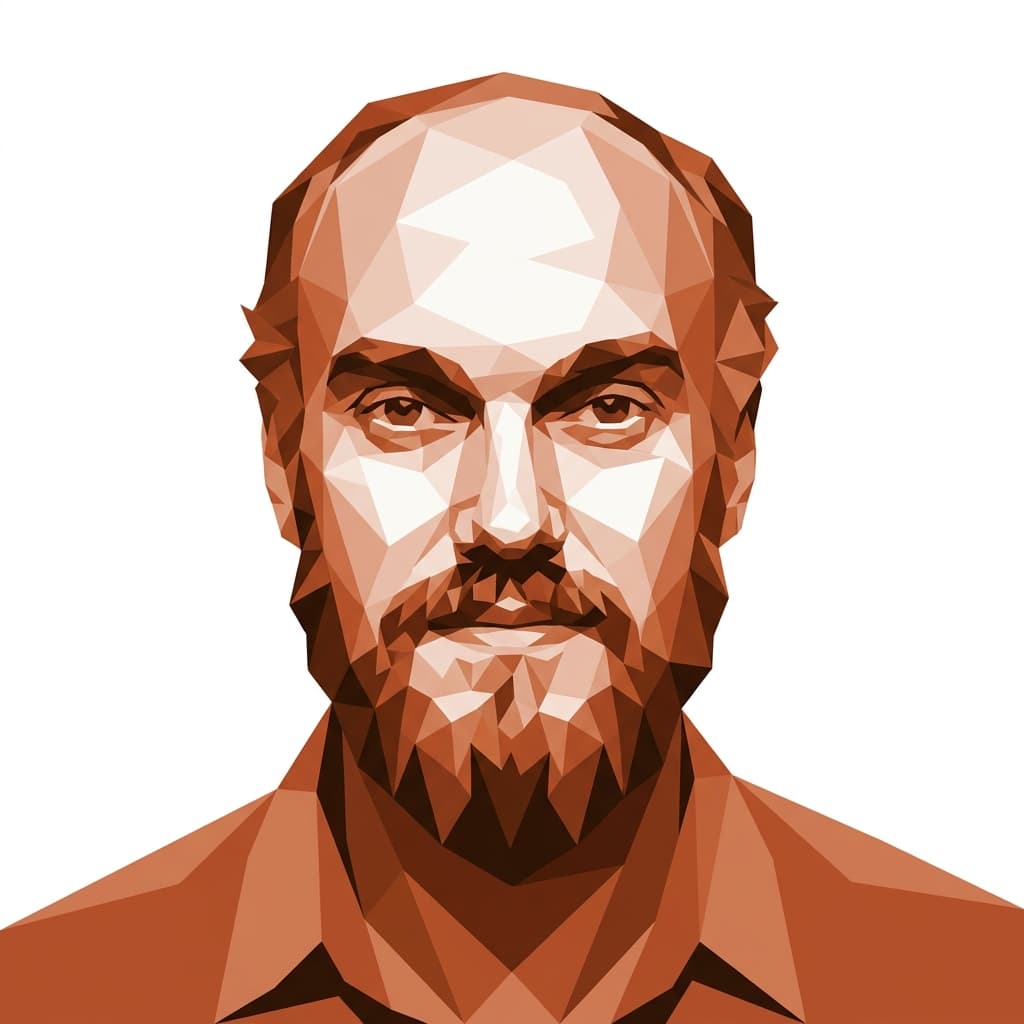
American spiritual teacher and author of Be Here Now who bridged Harvard psychology and Eastern mysticism.
Design
- Q54.3
- h53.3
- R47.4
- g51.5
- i57.5
- S38.2
- T34.4
- U7.1
- V53.1
- W38.6
- X21.3
- Y59.6
- Z53.6
Personality
- Q51.1
- h57.1
- R9.2
- g21.6
- i48.6
- S27.3
- T37.2
- U56.6
- V39.3
- W61.3
- X51.1
- Y59.4
- Z53.4
Ram Dass — born Richard Alpert in Boston in 1931 — was a Generator, built with the kind of consistent, masterful energy that let him dig into one subject, exhaust it, and then dig into the next. His life had three obvious chapters: hotshot Harvard psychologist, psychedelic outlaw alongside Timothy Leary, and the bearded American sadhu who came back from India with a new name and the book that would sit on a million nightstands. Each chapter required him to fully use up what he had before the next one could arrive.
In the early 1960s he was tenured at Harvard, driving a Mercedes, throwing dinner parties, and quietly miserable. He and Leary started feeding psilocybin to graduate students, then to each other, then to anyone curious — a 1/3 profile experiment in the most literal sense, investigating the foundations of consciousness through unrepentant trial and error. Harvard fired them in 1963. He spent the next several years chasing the experience the chemicals had pointed at, the kind of restless searching that needs a real object to respond to, and in 1967 he flew to India essentially on a hunch.
What happened there is the hinge of his life. He met Neem Karoli Baba, a blanket-wrapped old man in the Himalayan foothills, and something cracked open that LSD had only gestured at. The guru renamed him Ram Dass — servant of Ram — and sent him home. Back in America he wrote Be Here Now in 1971, a hand-lettered, hand-illustrated paperback that became a generational text. The book worked because it was a real story told from inside a real life, not a lecture; he was making meaning out of his own wreckage and offering the epiphanies he'd patiently waited years to land as a map for anyone else stumbling toward the same questions.
For the next four decades he lectured, taught, and quietly funded things. He co-founded the Seva Foundation to restore eyesight in the developing world and the Prison-Ashram Project to bring meditation to inmates — caregiving directed outward through structures that could actually hold it. He spoke about death and dying before American culture wanted to hear about either, sitting with terminally ill people and writing Still Here about his own aging. He was a reluctant guide, recognized into the role rather than reaching for it, forever insisting he was a fellow traveler, not a teacher.
In 1997 a massive stroke left him aphasic and partially paralyzed. He called it "fierce grace." The man who had spoken for a living now had to wait for words, and he treated the whole ordeal as further curriculum — meeting the shock as another doorway rather than an ending. He lived his last two decades on Maui, giving satsang from a wheelchair, his sentences slower but somehow more weighted, emotion-provoking simply by being present. When he died in December 2019, the obituaries all reached for the same phrase he'd given them fifty years earlier. He was, finally, here. Now.
Sources: biography · birth data
What do you and Ram Dass have in common?
Enter your birth details to find out