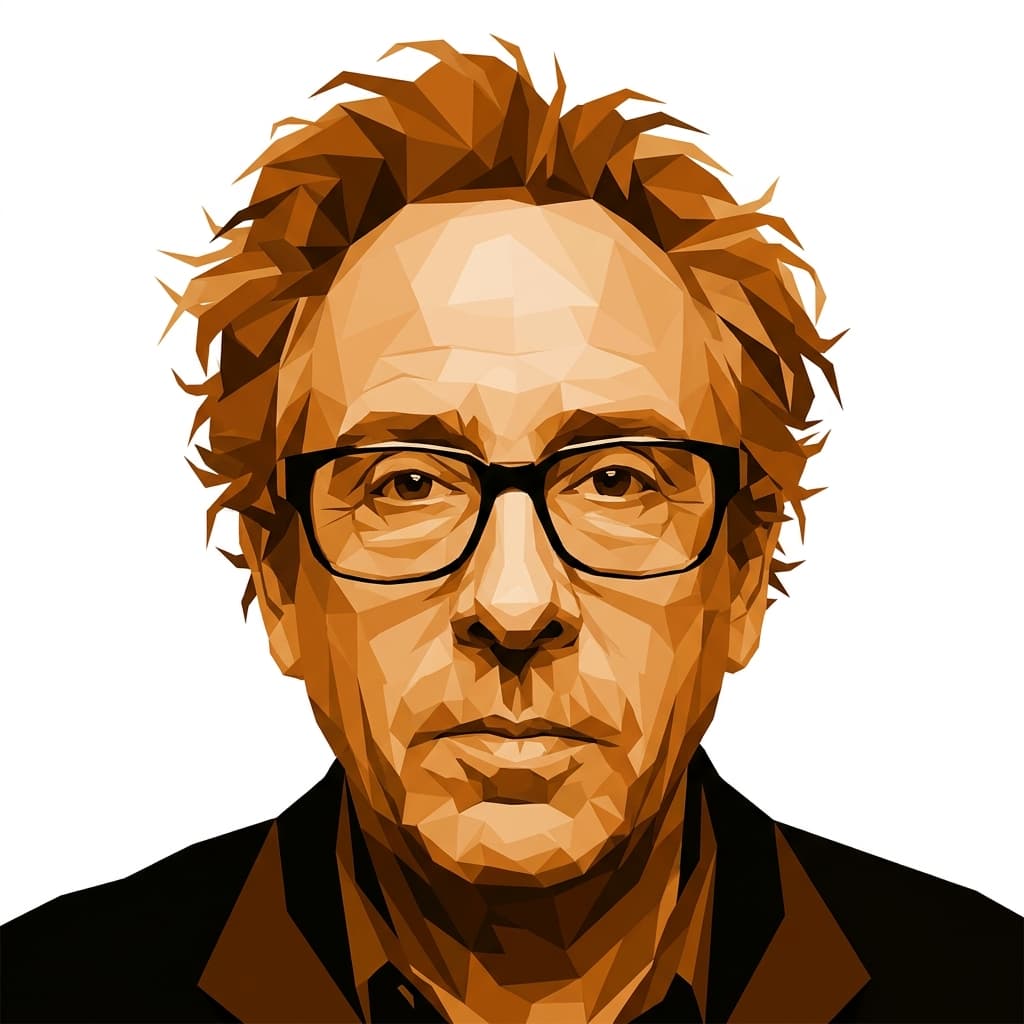
American filmmaker behind Beetlejuice, Edward Scissorhands, and a gothic visual world all his own.
Design
- Q20.5
- h34.5
- R40.1
- g50.5
- i3.5
- S24.5
- T42.3
- U22.5
- V32.2
- W11.2
- X33.1
- Y28.1
- Z29.6
Personality
- Q59.3
- h55.3
- R60.2
- g32.4
- i42.4
- S29.4
- T33.6
- U23.2
- V50.2
- W26.3
- X7.1
- Y28.1
- Z59.3
Tim Burton is a Manifesting Generator — wired to move fast, chase several obsessions at once, and skip the steps other people insist on taking. That much is obvious from his origin story: a suburban kid in Burbank who filled notebooks with monsters, got a Disney animation fellowship, and within a few years had been quietly fired for drawing things too strange for family features. The short Vincent, made on Disney's dime and shelved almost immediately, is the whole pattern in miniature — bringing order to what looked like unusable chaos by insisting his weird thing was actually the thing.
His 3/5 profile — the experimenter who becomes a reluctant authority — shows up in how his career actually unfolded. Pee-wee's Big Adventure was a gamble that shouldn't have worked; Beetlejuice was a script nobody knew how to make; Batman was a hire that half of Hollywood thought was insane. Burton kept saying yes to projects the industry had written off, learning by doing rather than by plan, and each near-disaster built the reputation that made the next one possible. He's spoken often about not really knowing what he was doing on any given film — a very 3/5 admission from someone the studios eventually treated as an oracle.
The look of a Burton film — the spiral hills, the striped stockings, the pale hands — is a whole aesthetic dialect, and it's the work of somebody translating something interior into a language other people can actually read. His sketches come first; the movies are built around them. He's described the process as waiting for images to arrive rather than manufacturing them, letting insight surface on its own timing instead of forcing a concept into shape. Edward Scissorhands, Jack Skellington, the Corpse Bride — these characters existed as drawings for years before they found their films.
Burton is famously private, notoriously bad at press, and prone to long stretches of retreat between projects. Friends and collaborators describe him as gentle and quiet in person, nothing like the goth caricature. He works from a gut-level yes or no that he can't really explain — casting Michael Keaton as Batman over massive studio objection, casting Johnny Depp as Edward after one meeting, saying no to Batman Forever when the tone shifted. When the response isn't there, he simply won't do it, which has cost him jobs and probably saved his voice.
His long collaborations — Depp, Danny Elfman, Helena Bonham Carter, Winona Ryder, Catherine O'Hara — read as the kind of bonds built slowly with the people who actually get it. Elfman has scored nearly every Burton film since 1985; it's one of the longest director-composer partnerships in American film. Burton tends to protect the small world of misfits he's gathered around him, and to give the outsider characters the moral center his stories orbit — the emotional lows treated as gifts, not problems to solve.
Even the recent second act — Wednesday on Netflix, the Beetlejuice sequel — feels less like a comeback than a return to what always lit him up: drawing weird things, hiring the friends, and letting the odd child in the audience know they weren't the only one.
Sources: biography · birth data
What do you and Tim Burton have in common?
Enter your birth details to find out