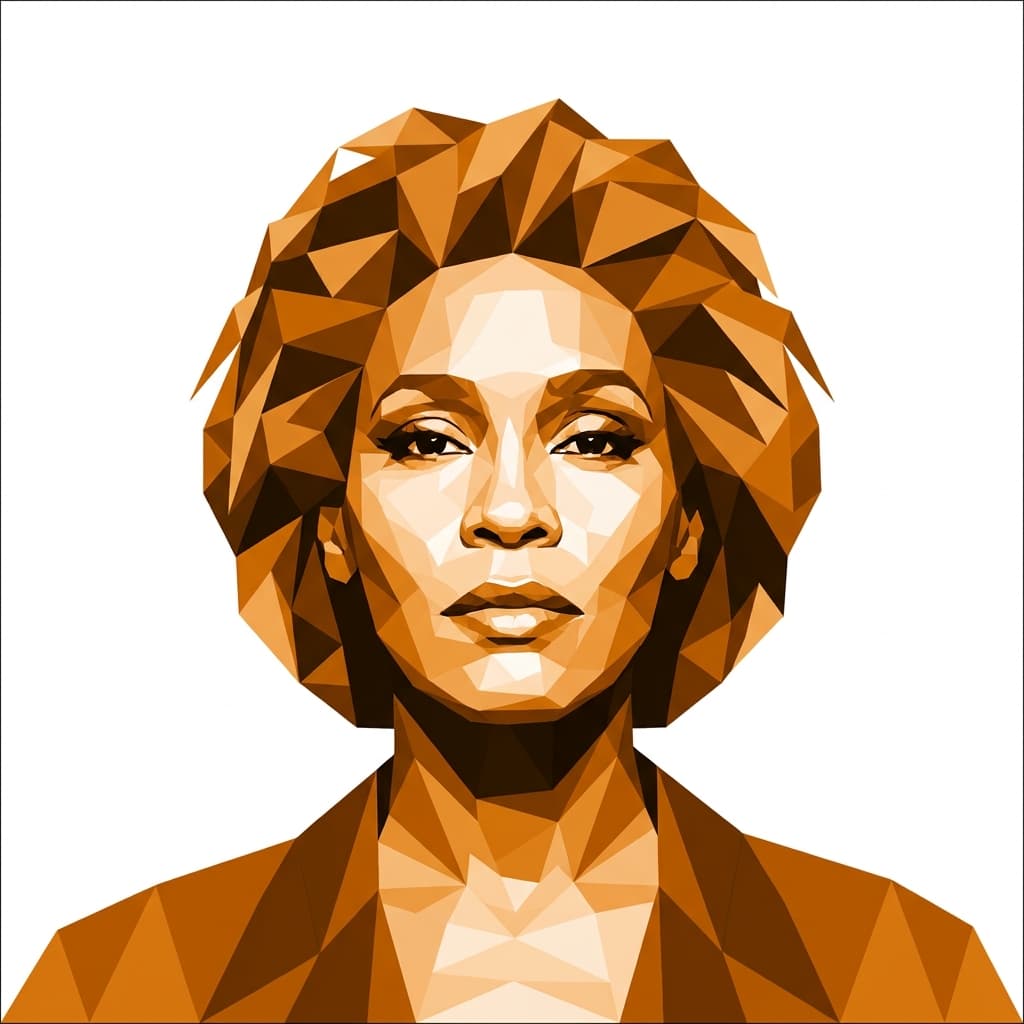
American singer and actress whose voice defined a generation of pop and R&B music.
Design
- Q2.6
- h1.6
- R34.4
- g62.2
- i61.2
- S20.1
- T51.5
- U7.6
- V17.5
- W49.5
- X59.2
- Y1.1
- Z40.5
Personality
- Q7.4
- h13.4
- R51.3
- g53.6
- i54.6
- S40.5
- T33.4
- U18.5
- V51.5
- W49.2
- X59.5
- Y44.6
- Z40.6
Whitney Houston was a Manifesting Generator — wired for speed, sustained power, and several careers running in parallel — and her arc moved exactly that way, from Newark church choir to model to recording artist to film star, often within the same handful of years. She didn't pick a lane. She made the lanes converge.
She grew up inside the music. Her mother Cissy was a gospel singer; Dionne Warwick was a cousin; Aretha Franklin was around. Whitney sang solos at New Hope Baptist before she was a teenager, then worked as a backup singer and a Glamour model while still in high school. That early density of experience — the experimentation, the visibility, the false starts before Clive Davis signed her at nineteen — is the texture of a profile built to become a role model through lived experience, where the messy first act is the training for the public second one. When she debuted in 1985, the world met someone who already knew how to stand on a stage.
The voice itself was pure original self-expression that couldn't be imitated without sounding small. What made it land, though, was how she chose what to do with it. "The Greatest Love of All," "I Wanna Dance with Somebody," "I Will Always Love You" — these were songs she said yes to, not songs she chased. Her Strategy of waiting for the right thing to show up and following the gut response was visible in how selective her catalog actually was for someone with that level of output, and how completely she committed once her body gave her a full-bodied yes. The 1991 Super Bowl national anthem was famously a one-take performance. She walked in and delivered.
Onstage she had the kind of raw vitality that lifted entire rooms and a presence that made each note feel like it was happening for the first time, right then. The Bodyguard soundtrack in 1992 made her the best-selling female artist of the era, and the film itself — her acting debut — proved she could carry a movie the same way she carried a melody: by being brave enough to walk into something entirely new without an obvious template. Waiting to Exhale and The Preacher's Wife followed in the same restless pattern, the multi-passionate non-linear path of someone who refused to pick just one room to stand in.
The harder years were public. The marriage to Bobby Brown, the addictions, the canceled tours, the voice that began to fray — all of it played out under cameras. People close to her described someone who carried other people's stories and pressures more than she let on, who needed solitude and retreat to process what she was absorbing but rarely got enough of it. The 2009 comeback album, I Look to You, hinted at the wisdom she had earned. She died in 2012 at 48.
What endures is the recordings, and underneath them, the willpower to provide — for family, label, audience — sometimes past her own limit. The voice was the gift. The life was the lesson the 4/6 was always going to teach.
Sources: biography · birth data
What do you and Whitney Houston have in common?
Enter your birth details to find out