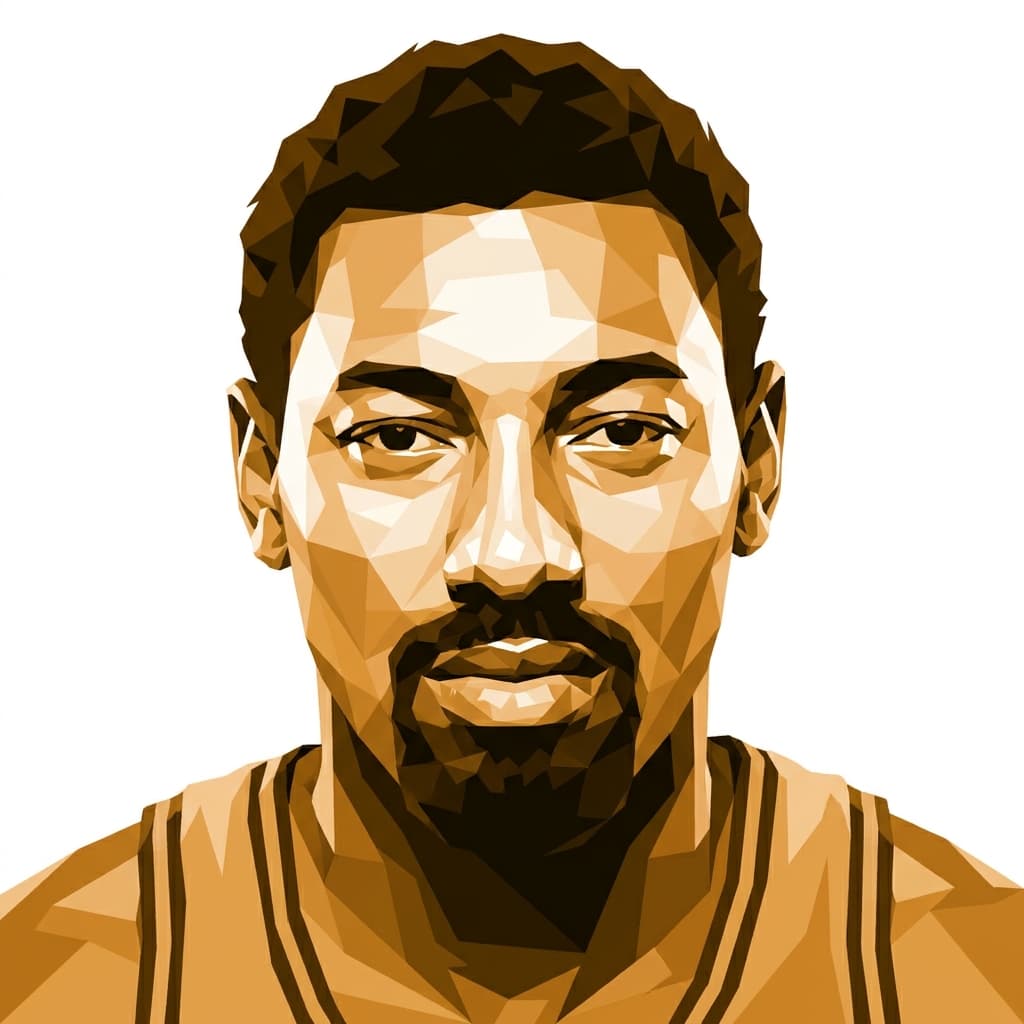
NBA legend whose dominance, statistical extremes, and outsized personality reshaped basketball forever.
Design
- Q20.1
- h34.1
- R45.2
- g10.6
- i15.6
- S35.3
- T23.2
- U16.1
- V26.6
- W22.5
- X27.6
- Y64.3
- Z62.6
Personality
- Q29.5
- h30.5
- R32.5
- g10.4
- i15.4
- S47.6
- T64.3
- U31.6
- V5.4
- W22.4
- X24.3
- Y64.5
- Z56.2
Wilt Chamberlain was a Manifesting Generator — a 7'1" engine wired to chase several passions at once, and the arc of his life refused to stay inside the lane basketball drew for him. Track athlete, volleyball Hall of Famer, Harlem Globetrotter, NBA scoring machine, Conan the Destroyer co-star, professional bachelor, racehorse owner, polo player. The world wanted him to be just a center. He was constitutionally incapable of being just anything.
On March 2, 1962, in a half-empty arena in Hershey, Pennsylvania, he scored 100 points against the New York Knicks — a number that still sits alone in the record book sixty years later. That season he averaged 50.4 points per game. These aren't basketball statistics so much as evidence of raw, self-generating power directed at whatever lit him up, paired with the kind of repetitive, obsessive practice that turns talent into inevitability. He shot free throws underhanded, then overhand, then underhanded again, chasing his own rhythm rather than anyone else's coaching. When the league widened the lane to slow him down, he scored anyway.
His 5/1 profile — the practical problem-solver built on a deep investigative foundation — explains the strange shape of his career. He'd master one thing (scoring), then announce he was bored with it and pivot to leading the league in assists, just to prove he could. He took on the projections coaches and reporters threw at him ("he can't win the big one," "he's selfish") and answered them with decisions that didn't require explanation — a championship in 1967, another in 1972, an MVP, a Finals MVP, the records nobody asked him to break.
Off the court, the same restless variety showed up as a hunger for the full spectrum of experience and an appetite for new horizons that never quite settled. He drove Bentleys, built a mansion called Ursa Major with a retractable roof over the bed, owned nightclubs, dated relentlessly, traveled constantly. He was unapologetically himself in a way that made other people uncomfortable — including the infamous 20,000-women claim in his 1991 memoir, a number nobody believed and he never softened, delivered with the bluntness of someone who said what he meant when he meant it.
He had a salesman's instinct for making the moment marketable, whether negotiating his own contracts (he was the first NBA player to make $100,000, then the first to make $200,000) or pitching himself for movie roles. He was also a natural storyteller who turned his life into legend in real time, often exaggerating, often charming, always entertaining. Teammates called him generous; opponents called him dominant; sportswriters called him difficult. He was all three, refusing to simplify himself for anyone's convenience.
Chamberlain died in 1999 at 63, in the Bel Air home he designed himself, alone by choice. The standard reading is that he was lonely. The more honest reading is that he'd spent his life waiting for what genuinely lit him up and then pursuing it at full speed, and solitude was simply one more thing he'd chosen on purpose.
Sources: biography · birth data
What do you and Wilt Chamberlain have in common?
Enter your birth details to find out