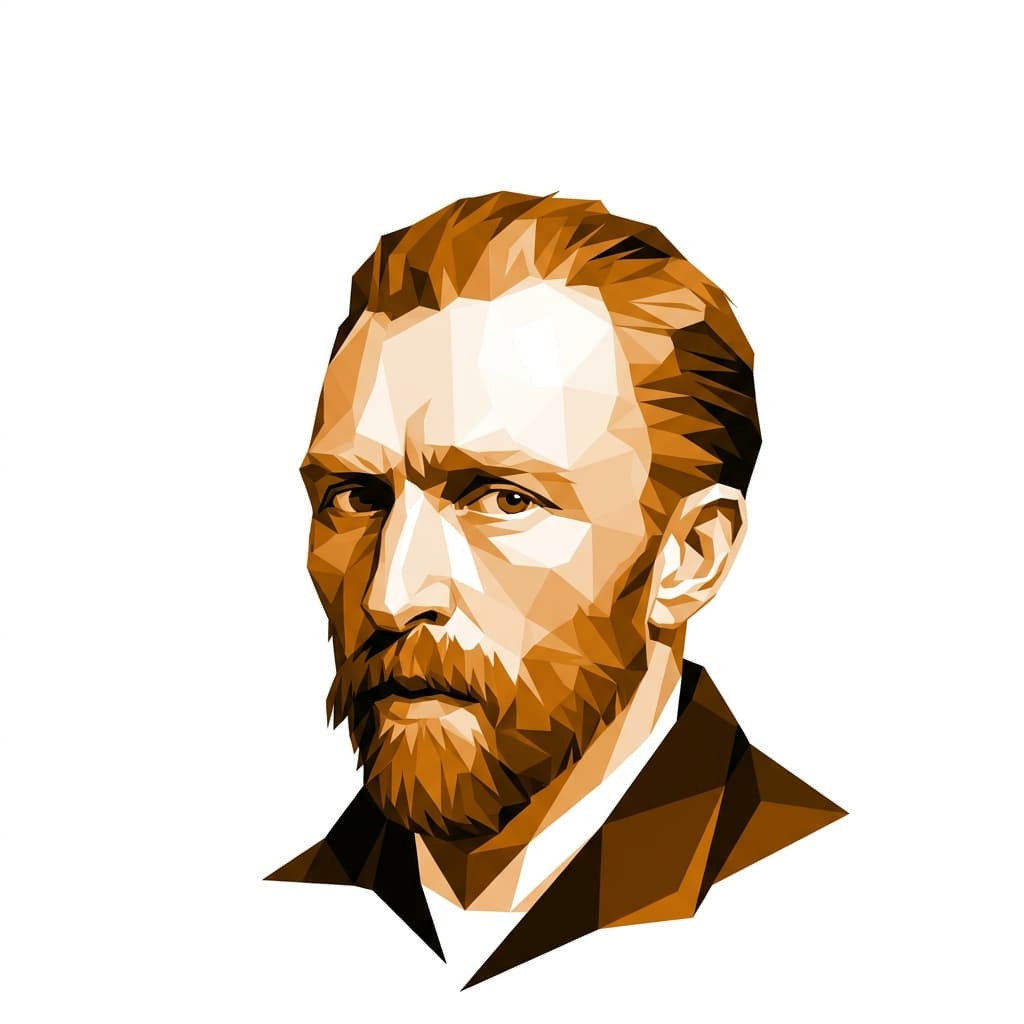
Dutch Post-Impressionist painter whose intense, luminous work transformed Western art after a brief, turbulent decade of painting.
Design
- Q38.3
- h39.3
- R46.3
- g15.1
- i10.1
- S26.5
- T9.5
- U54.3
- V5.1
- W24.4
- X27.3
- Y37.4
- Z3.4
Personality
- Q21.1
- h48.1
- R26.4
- g45.6
- i26.6
- S42.6
- T36.6
- U36.4
- V11.2
- W2.3
- X27.6
- Y63.1
- Z3.5
Vincent van Gogh was a Manifesting Generator — wired to burn through several lives at once, and he did exactly that, cycling through art dealing, teaching, lay preaching, and bookselling before finally picking up a brush at twenty-seven. The decade that followed produced roughly 2,100 works. He died at thirty-seven having sold, by most accounts, almost none of them.
His early years read like a 1/3 profile in motion: deep study followed by crash-and-burn experiments. He apprenticed at the Goupil gallery in The Hague, then London, then Paris, and was dismissed for arguing with clients about which paintings mattered. He tried theology, failed the entrance exams, then went to the Borinage coal country as a missionary and gave away his clothes and salary to the miners — a gesture so uncompromisingly aligned with who he actually was that the church committee fired him for excessive zeal. Each collapse became material. He wrote to his brother Theo that he was learning by doing, badly, and would keep doing it badly until he didn't.
When he finally committed to painting, the pace was staggering. In Arles in 1888 he produced over 200 canvases in fifteen months, often one a day, chasing the thing in his gut that said yes right now and skipping meals to do it. The Yellow House, the sunflower series, the night cafés — all of it came out of a man who had learned to move the instant the response landed and informed Theo of the results in roughly 650 letters. He wrote constantly about color theory, Japanese prints, peasant dignity, Delacroix. The letters are themselves a body of work.
The paintings carry a focus on small details others walked past — the specific blue of a postman's uniform, the particular yellow of chair straw, the way wheat moves in wind. He studied Millet's peasants for years before producing his own, bringing fierce care to lives most painters ignored. His letters to Theo show a mind that built frameworks slowly, in solitude, then released them whole: theories of complementary color, of the modern portrait, of what a studio of the South might become. The Gauguin collaboration at Arles was that theory made flesh — and the ear incident, nine weeks later, was the emotional storm he could not wait out before acting.
He fought for things that mostly didn't fight back. He fought his father over religion, fought Gauguin over aesthetics, fought the villagers of Arles who petitioned to have him committed, fought his own brain in the asylum at Saint-Rémy where he painted Starry Night from a barred window. The warrior drive without a worthy opponent turned inward in the end. Yet even at Auvers in the final seventy days he produced roughly a canvas a day, including Wheatfield with Crows. His posthumous reputation was built almost entirely by his sister-in-law Johanna, who inherited the paintings and spent the rest of her life persuading a skeptical world of what she already knew they were worth.
Sources: biography · birth data
What do you and Vincent van Gogh have in common?
Enter your birth details to find out