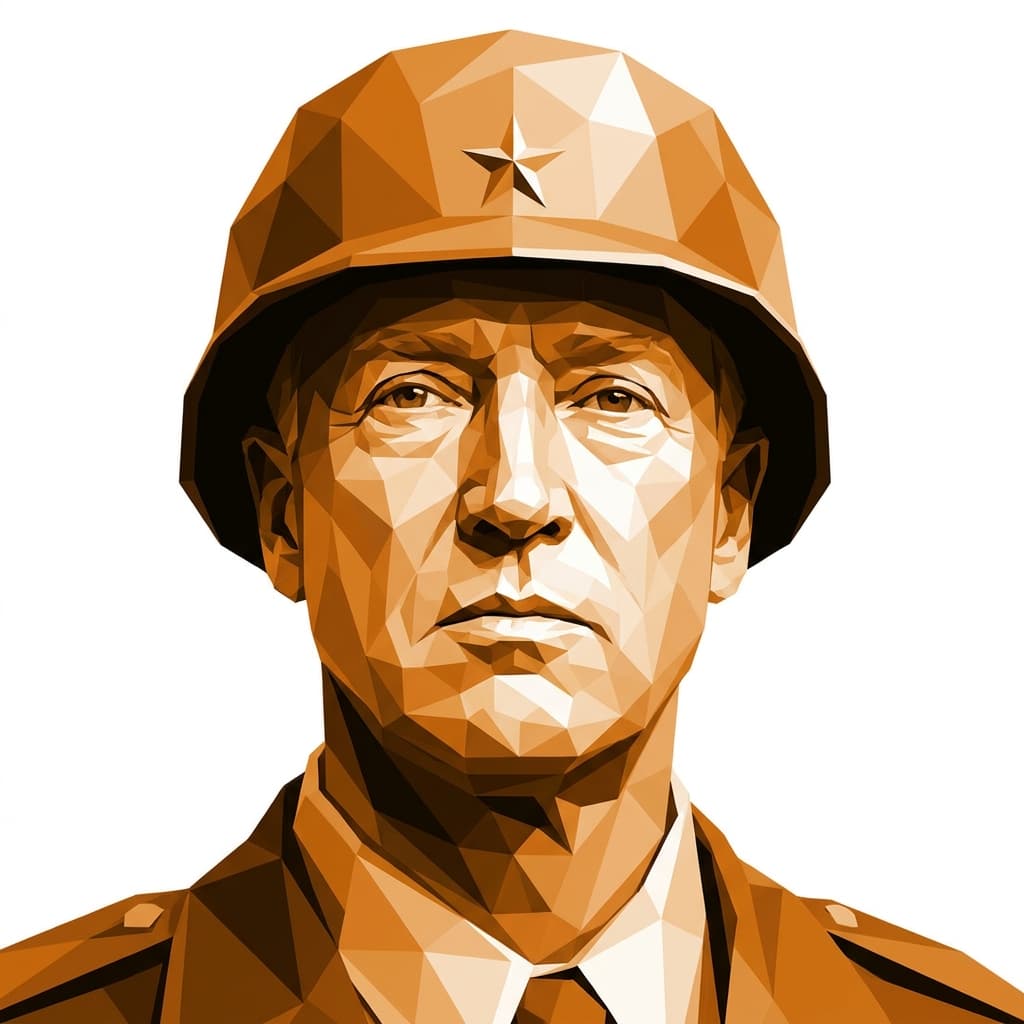
American WWII general known for aggressive armored warfare, ivory-handled pistols, and blunt, controversial leadership.
Design
- Q4.4
- h49.4
- R57.2
- g6.4
- i36.4
- S47.1
- T47.3
- U52.6
- V40.6
- W52.1
- X46.3
- Y8.2
- Z20.4
Personality
- Q43.2
- h23.2
- R54.5
- g6.2
- i36.2
- S34.6
- T58.2
- U59.2
- V46.2
- W52.5
- X18.3
- Y23.6
- Z20.3
George S. Patton was a Manifesting Generator — built for speed, capable of sustained aggression, and constitutionally incapable of moving at anyone else's pace. His entire career reads like a man trying to outrun his own restlessness: cavalry officer, Olympic pentathlete, tank pioneer, then the commander who drove the U.S. Third Army across France faster than the supply lines could keep up. When Eisenhower's staff asked him to slow down and consolidate, Patton famously found ways not to — chasing several passions and campaigns at once, skipping steps he considered non-essential, and daring his superiors to rein him in.
Beneath the pearl-handled revolvers and the profanity was a 2/4 profile — the hermit who is also the networker. Patton spent enormous stretches of his life alone with books: military history, Caesar, Napoleon's campaigns, Rommel's own writing on tank warfare. He believed, sincerely, that he had lived past lives as a soldier, and he read in solitude to recover what he thought he already knew. Then he'd emerge to command through relationships — the loyal circle of officers and enlisted men who followed him from North Africa to Sicily to the Ardennes, and who carried his opportunities to him through the network more than through official channels.
His decision-making was famously volatile, and the pattern fits an Emotional Authority that he rarely gave time to settle. The 1943 slapping incidents in Sicily — striking two hospitalized soldiers he accused of cowardice — were exactly the kind of choices made from the top of the emotional wave rather than the calm after it. It nearly ended his career. When he did wait, when he sat with a plan for days and let the initial charge fade, his operational judgment was startling; the pivot of Third Army ninety degrees north to relieve Bastogne in December 1944 is still taught as one of the great feats of staff work.
Patton was a fierce critic of anything he considered slack or badly run, and he directed that instinct for what wasn't working outward with a vengeance — at British commanders, at his own quartermasters, at the entire pace of Allied planning. He had an appetite for improvement that bordered on obsession, rewriting training manuals, redesigning the cavalry saber, and drilling his men until they hated him and then, mysteriously, loved him. His speeches to the troops were pure say-only-what-needs-saying, sharpened to shock — vulgar, quotable, and calibrated to land in the moment they were delivered.
He believed in what he called the soldier's principles, worth dying and killing for, and he was baffled when postwar politics required him to soften them. Reassigned after the war for making inflammatory comments about denazification and the Soviets, he saw flaws in the peace others weren't ready to hear about, and said so anyway. He died in December 1945 from injuries sustained in a low-speed car accident outside Mannheim — an oddly quiet end for a man who had spent sixty years running on pure vitality and forward motion, certain he was in the right place at the right moment, and usually right about it.
Sources: biography · birth data
What do you and George S. Patton have in common?
Enter your birth details to find out